
Quick Answer
Is SEO still effective for small businesses in 2026? Yes, but not in the old way. SEO still works when you target what people actually search for, build clear service pages, strengthen your local presence, earn trust, and publish genuinely helpful content. The old tricks, like keyword stuffing, random backlinks, and thin blog posts, no longer work and can hurt you.
When is SEO worth it? When you have a real offer, a working website, and the patience to build over months. It is especially strong for local service businesses and anyone whose customers search before they buy.
When is SEO not worth it? When you need leads this week, when your offer or website is weak, or when you expect quick wins with no ongoing effort. SEO is a long-term channel, not a fast lead machine.
Should small businesses use SEO, paid ads, or both? Many do best with both. SEO builds lasting visibility and trust over time. Paid ads give you fast traffic, quick testing, and immediate visibility. They solve different problems, and they work well together.
Introduction
There are two loud and opposite messages online. One says SEO is dead, killed by AI search. The other says SEO is essential and every business must do it. Both are too simple.
The honest answer sits in the middle, and it depends on your situation. This guide gives you a straight answer with no hype, no fake statistics, and no sales pitch. It explains when SEO is genuinely worth your time and money, when it is not, and what modern SEO actually looks like for a small business in 2026.
Is SEO Still Effective for Small Businesses in 2026?
Yes, SEO is still effective, but the kind of SEO that works has changed. The version that wins today is built on real value, not on tricks.
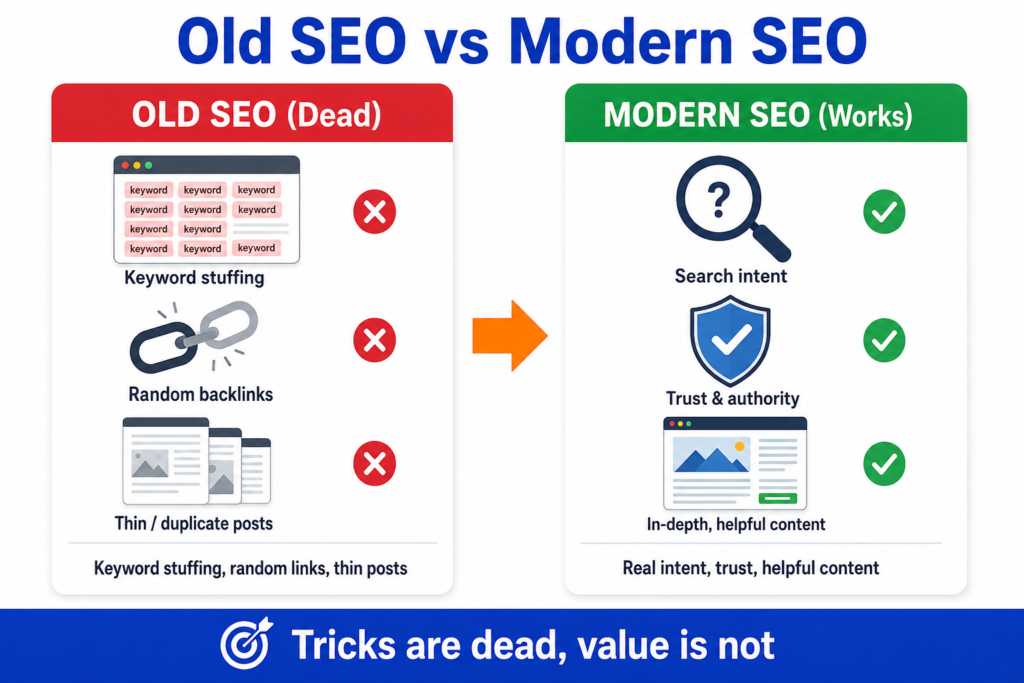
A useful way to see it is to separate two things. Old SEO was about gaming the system: stuffing keywords, buying links, and pumping out thin posts to chase rankings. That approach is now weak at best and risky at worst. Modern SEO is about being the genuinely useful, trustworthy answer to a real question, on a site that search engines can read and that people are glad they clicked.
For most small businesses, especially local ones, that modern version is very much alive. When a homeowner searches for an emergency plumber nearby, or someone looks for a dentist in their town, the businesses that show up with clear pages, strong reviews, and a good local presence win real customers. That is SEO doing exactly what it always promised.
Why Small Businesses Still Ask If SEO Is Worth It
The question keeps coming up for good reasons, and it is worth naming them honestly.
First, many owners tried SEO before and saw nothing. Often, that was because the work was thin, the expectations were unrealistic, or the site had basic problems that were never fixed.
Second, AI search has changed the results page. People see AI answers at the top now, and owners worry that nobody clicks through anymore.
Third, there is a lot of noise. Agencies promise quick rankings, tools promise magic, and the word SEO has been oversold for years. After enough broken promises, doubt is reasonable.
These are fair concerns. The rest of this guide takes them seriously rather than waving them away.
What Has Changed About SEO in 2026?
A few real shifts matter for small businesses. None of them mean SEO is dead, but they do change how you should approach it.
AI Overviews and AI answers now appear on a significant and growing share of US searches, with published estimates through 2025 ranging from roughly 15 to 25 percent depending on the month. They show up more often on informational questions and less often on local or buying queries.
When an AI answer appears, it can reduce clicks for some informational searches. The practical takeaway is that ranking is no longer only about being one of ten blue links. You also want to be a source the AI answer draws from, and you want to win the queries where people still click, which are often local and commercial. Optimising your posts for AI Overviews covers what Google has actually confirmed about how those answers pick their sources.
Search engines now lean harder on trust and experience. The idea Google describes as experience, expertise, authoritativeness, and trust matters more than ever. Content that shows real, first-hand knowledge stands out from generic filler.
Thin and mass-produced content is treated as a problem. Pumping out lots of generic posts, including low-effort AI content with nothing original added, is more likely to hurt you than help.
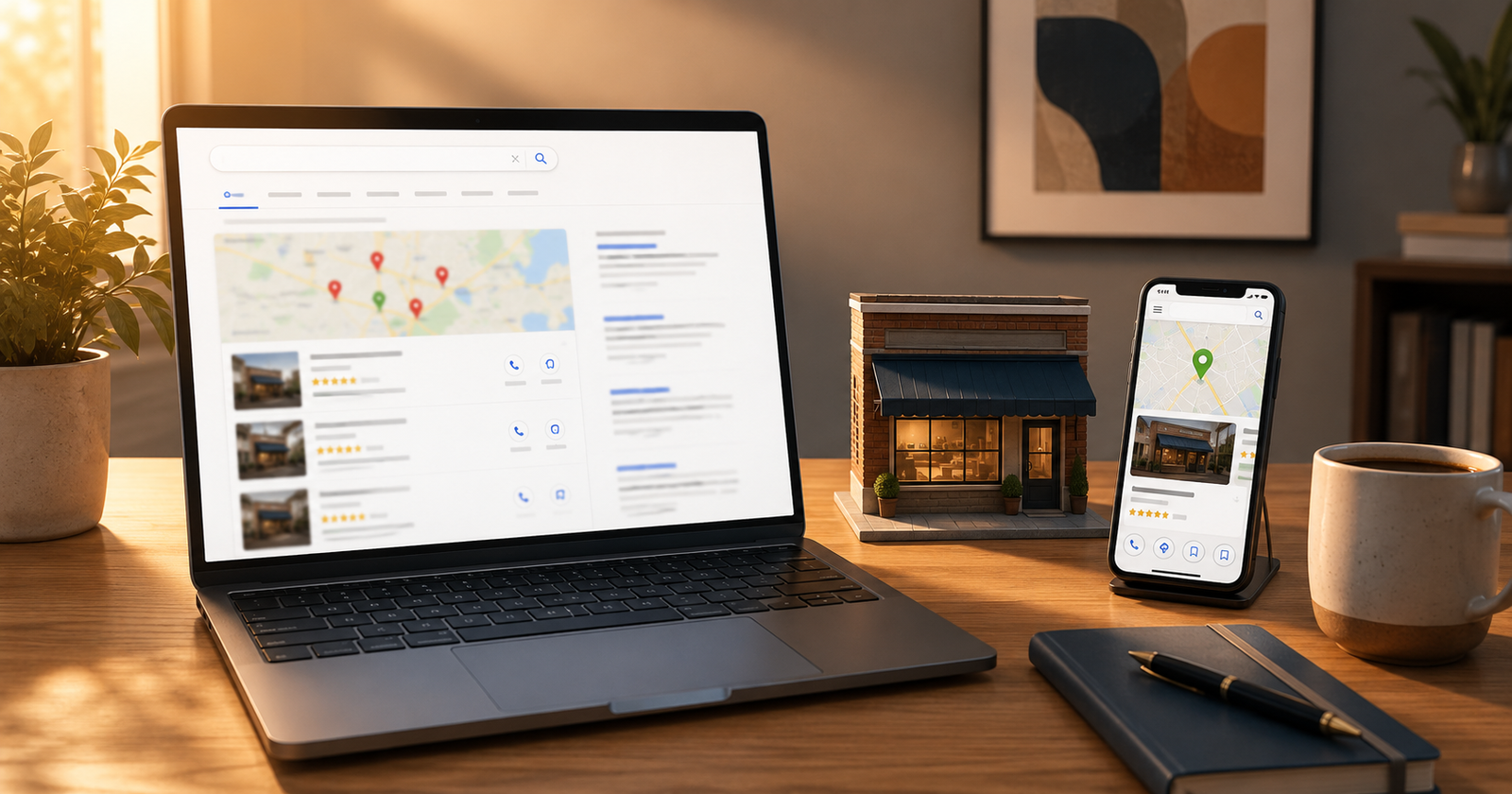
Local search remains strong for small businesses. The local results, maps, and Google Business Profile still drive real customers, and large competitors cannot always dominate a specific town or neighbourhood.
In short, the bar for quality went up, and the reward shifted toward businesses that are genuinely useful, trustworthy, and relevant.
When SEO Works for Small Businesses
SEO tends to work well in these situations.
Your customers search before they buy. If people type questions or services into Google before choosing, SEO puts you in front of them at the right moment.
You serve a local area. Local SEO is one of the best opportunities for small businesses, because the competition in one town is smaller than the whole internet. A local plumber, dentist, or salon can realistically rank for nearby searches.
You have a real offer and a working website. SEO sends people to your pages. If those pages are clear and the offer is good, SEO can turn searchers into customers.
You can be patient. SEO builds over months, then tends to compound. If you can invest consistently for a while, the results often keep growing without paying for every click.
You can show real experience. If you actually know your field and can show it, you can create content and pages that stand out in a sea of generic copy.
When SEO Does Not Work for Small Businesses
It is just as important to be honest about when SEO is the wrong choice or a wasted effort.
You need leads immediately. SEO is slow to start. If you need customers this week, paid ads or direct outreach are better first moves.
Your offer or website is weak. SEO can bring visitors, but it cannot fix a confusing site, a vague offer, or a page that gives people no reason to act. A local plumber with a single thin page that lists no services and no service area will struggle no matter how much SEO is done, because there is nothing for search engines or customers to grab onto.
You expect quick wins with no ongoing work. A one-time setup is not enough. A consultant who writes a few generic blog posts with no connection to their actual services, then stops, will usually see nothing, because the content does not match what buyers search for, and there is no consistency.
You are in an extremely competitive space with no edge. If giant national brands dominate every term and you have no local angle or niche, ranking can be very hard and slow.
You ignore local signals when you are a local business. A restaurant that pours everything into social media and never sets up or maintains its Google Business Profile misses the exact searches that bring in nearby diners.
None of these means SEO is useless. They mean SEO is the wrong tool, or it needs the basics fixed first.
SEO vs Paid Ads for Small Businesses
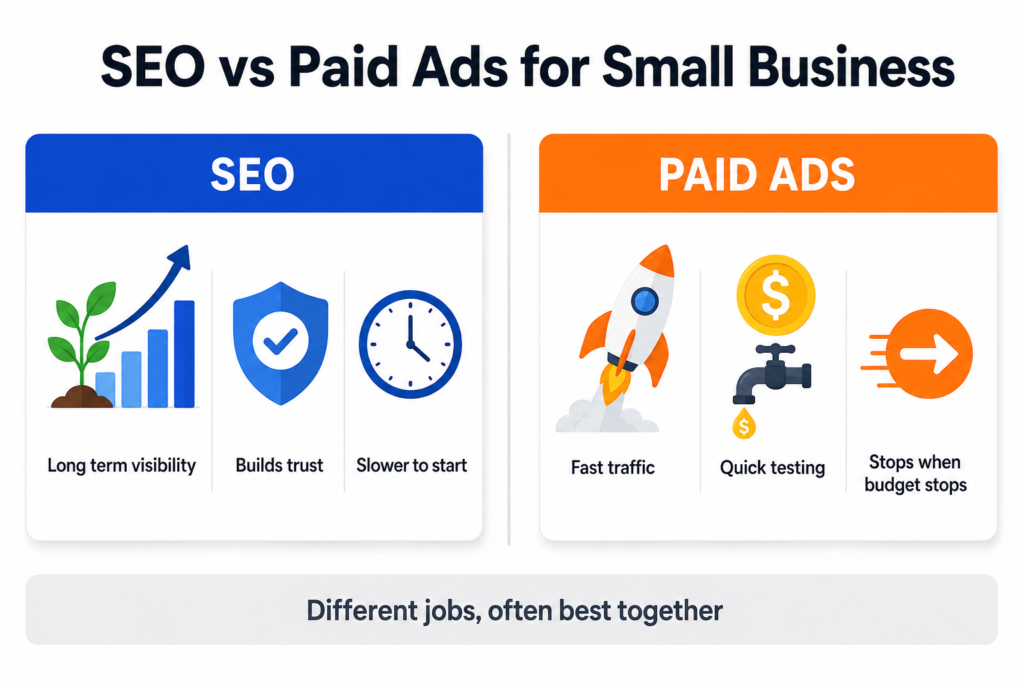
This is one of the most common questions, so here is a balanced view. Neither is always better. They do different jobs.
SEO is better for long-term visibility and trust. Once you rank, you can keep getting traffic without paying for each visitor, and high organic rankings tend to build credibility. The trade-off is that it is slower and needs content and technical work.
Paid ads are better for fast testing and immediate traffic. You can launch today and get visitors and data quickly, which is great for validating an offer or running a short campaign. The trade-off is that the moment you stop paying, the traffic stops. Budgets can start smaller than most people expect, and what a 10 dollar daily budget can realistically test gives a sense of the floor.
Our PPC budget calculator helps you estimate what a paid campaign can buy before you spend.
SEO is slower but can compound. Good content and pages can keep working for months or years. Paid ads do not compound in the same way, since results are tied to ongoing spend.
Both still need the fundamentals. SEO still needs time, content, and technical health. Paid ads still need a good offer, strong creative, a working landing page, and proper tracking. Neither rescues a broken offer.
The right choice depends on your cash flow, your timeline, your competition, and your goal. A new business that needs leads now might start with paid ads while building SEO in the background. An established local business might lean on SEO and local search while using ads for busy seasons. Many small businesses are best served by using both.
How Search Engines Evaluate Content Quality Today
You do not need to know the secret formula, because nobody outside Google does. But Google has been clear about what it is trying to reward, and that is enough to guide you.
Search engines aim to surface content that is genuinely helpful and made for people, not just for rankings. They look for signals of experience, expertise, authoritativeness, and trust. A page written by someone who clearly knows the subject, on a site that is transparent about who runs it, with accurate information, is the goal.
They also try to filter out low-value content. Thin pages, copied content, and mass-produced filler are treated as the opposite of helpful. Using AI to assist is allowed, but the page still has to add real value, not just exist to fill space.
For a small business, the practical version is simple. Write pages and posts that actually answer the question, show that a real and capable person stands behind them, keep the information accurate, and make the site easy to use. That is what quality means in practice.
What Small Businesses Should Focus On Instead of Old SEO Tricks
The old playbook is not just outdated; it can actively harm you. Here is the swap to make.
Instead of keyword stuffing, focus on matching search intent. Understand what the searcher actually wants and answer it directly.
Instead of buying random backlinks, focus on earning a few relevant mentions and building a genuinely useful site. Spammy links are a risk, not a shortcut.
Instead of thin blog posts published in bulk, focus on fewer, deeper pages that fully answer real questions.
Instead of mass AI content, focus on content with real experience, examples, and accuracy added by a human.
Instead of chasing traffic for its own sake, focus on traffic that turns into calls, forms, and sales.
The theme is consistent. Replace tricks aimed at the algorithm with value aimed at the customer. The algorithm increasingly rewards the same things customers do.
Modern SEO Strategy for Small Businesses
A modern small business SEO strategy does not need to be complicated. It rests on a few pillars.
Get the technical basics right so search engines can find and read your site. Make pages that target real search intent, especially your core services. Build a strong local presence if you serve an area. Create helpful content based on the questions your customers actually ask. Earn trust through transparency, reviews, and clear information about who you are. Then measure what matters, which is real leads and sales, not just clicks. Our on page SEO checklist covers each step.
The sections below break down the parts that matter most for small businesses.
Local SEO for Small Businesses
If you serve a local area, this is often your single biggest opportunity, and it is where small businesses can beat much larger ones.
Start with your Google Business Profile. Claim it, complete it fully, and keep it accurate. Your name, address, phone number, hours, services, and photos all matter. Encourage satisfied customers to leave honest reviews, and respond to them.
Make sure your business details are consistent everywhere they appear online. Mismatched addresses or phone numbers confuse both customers and search engines.
Create location-relevant pages on your site if you serve specific areas. A dental clinic with no local landing pages, relying on a single generic homepage, misses the searches that include a town or neighbourhood name. Clear local pages help you show up for those.
Local SEO is often the most cost-effective SEO a small business can do, because the audience is nearby and ready to act.
Service Page SEO for Small Businesses
Service pages are where many small businesses leave money on the table. These are the pages that target people who are close to buying.
Each main service should usually have its own clear page, not a single page that lumps everything together. A plumber who buries drain cleaning, boiler repair, and emergency callouts into one vague paragraph gives search engines and customers very little to work with. Separate, clear pages for each core service tend to perform far better.
A strong service page explains what the service is, who it is for, what is included, the area you serve, and why someone should choose you. It answers the obvious questions a buyer has, and it makes the next step easy with a clear way to call or enquire.
Adding a short set of frequently asked questions to a service page is a simple way to cover related searches and the questions buyers actually ask.
Blog Content Strategy for Small Businesses
Blogging still has a place, but only when it is done with purpose. Random posts that have nothing to do with your services rarely help.
The better approach is to write content that answers the real questions your customers ask before they buy. Think about what people want to know when they are choosing a service like yours, and answer those questions clearly and honestly.
Quality beats quantity. A small number of genuinely useful posts that reflect your real experience will do more than a flood of thin, generic articles. And content works best when it connects back to your services, so a reader who arrives from a question can easily find the service that helps them. The elements of a content marketing strategy covers how to plan that connection before you start writing rather than after.
Our content calendar generator can help you plan those topics into a posting schedule.
Do not publish thin AI content to have something new. It is more likely to weigh your site down than lift it.
Trust Signals for Small Business Websites
Trust is something you build, and it matters more than ever. A few practical steps go a long way.
Make it clear who is behind the business. A real About page, a clear contact page, and a visible address or service area all help. Show real reviews and testimonials. Use your own photos rather than generic stock images where you can. State accurate information and back up claims where it makes sense.
Search engines and customers are looking for the same thing here: evidence that a real, accountable business stands behind the site. The more obvious you make that, the better.
Common Misconceptions About SEO Today
A lot of confusion comes from beliefs that are wrong. Here are the big ones.
SEO is dead. It is not. It has changed. Tricks are dead, value is not.
SEO is free. It is not. It costs time, effort, and often money, even when you do it yourself.
SEO works overnight. It does not. Meaningful results usually take months, not days.
Blogging alone is SEO. It is not. Blogging is one part, and it is only useful when it serves a real intent and connects to your business.
AI content can rank without human value. Generic, mass-produced content with nothing original added is risky, not a shortcut.
Backlinks alone fix everything. They do not. Relevance, content quality, and trust matter more than chasing links.
Keywords matter more than intent. They do not. Matching what the searcher actually wants matters more than repeating a phrase.
Traffic matters more than leads. It does not. Visitors who never become customers do not pay the bills.
One SEO plugin is enough. A plugin helps with basics, but it is not a strategy.
A one-time audit is enough. SEO is ongoing. Search, competitors, and your own content all keep changing.
Recent Search Changes That Affect Small Business SEO
A few recent shifts are worth keeping on your radar, described plainly and without overstating them.
The rise of AI answers means some informational clicks now stay on the results page. For small businesses, the response is to focus more on local and commercial searches where people still click, and to write clear, quotable content that AI answers can cite.
The continued emphasis on helpful, people-first content means thin and generic pages are riskier than ever. Quality and real experience are rewarded.
The ongoing importance of local results means your Google Business Profile and reviews carry real weight for local businesses.
You do not need to chase every update. If you focus on being genuinely useful, trustworthy, and locally relevant, you are aligned with the direction search has been moving for years. When a drop does line up with a confirmed update, adapting your site after a Google update walks through how to diagnose it properly instead of guessing.
What Small Businesses Should Do in the First 90 Days
If you are starting from scratch, here is a realistic plan for the first three months. It does not promise rankings or leads, but it builds the right foundation.
Fix the technical basics, so your site loads reasonably fast, works on mobile, and has no obvious errors.
Improve your homepage clarity, so a visitor understands what you do, who you help, and what to do next within seconds.
Build or improve your service pages, with a clear page for each main service.
Set up Google Search Console, so you can see how Google views your site.
Review which pages are indexed, and fix anything important that is missing. A page can also be indexed and still never rank, which is a different problem with different fixes.
Improve your Google Business Profile, completing every field and adding photos.
Add local proof, such as reviews, service areas, and real local details.
Add a short set of frequently asked questions to your service pages.
Create a few pieces of content based on real buyer questions, not random topics.
Build internal links, so related pages connect and visitors can move between them.
Set up tracking for calls, forms, and real leads, so you measure outcomes, not just clicks.
Update weak or thin pages, improving them rather than leaving them as they are.
Avoid publishing thin AI blogs to add volume.
By the end of 90 days, you will not necessarily see big rankings yet, but you will have a clean, clear, trustworthy site that is set up to improve over time.
How to Know If Your SEO Is Working
Judge SEO by the right signals, and give it time. Looking only at rankings or judging after a couple of weeks leads to bad decisions.
Watch whether your impressions and clicks in Google Search Console grow over the months. Watch whether you start appearing for more relevant searches. Most importantly, watch real business outcomes, such as calls, form submissions, and enquiries, because that is what actually matters.
Be patient and consistent. SEO tends to be slow at first and then builds. If, after several months of genuine effort, you see no movement at all in impressions or relevant queries, that is a signal to review your content, your pages, or your technical setup, rather than to give up on the channel entirely.
Practical SEO Checklist for Small Businesses
Work through this to cover the essentials. If the site itself is brand new, our SEO
checklist for a new website covers the setup steps that come before any of this.
- A clear business offer that a stranger understands quickly
- Clear service pages, one for each main service
- Local pages where you serve specific areas
- A complete and accurate Google Business Profile
- A mobile friendly website
- Fast loading pages
- Helpful content based on real customer questions
- Real author or business details on the site
- A clear contact page
- A real About page
- Visible reviews and testimonials
- Internal links between related pages
- Schema markup where it is useful, such as for local businesses or FAQ
- Google Search Console set up
- A sitemap submitted
- Indexing checked for your key pages
- Old thin pages improved or removed
- No copied content
- No fake claims or invented reviews
- Tracking in place for calls and form submissions
.
Frequently Asked Questions
Helpful Resources
Source: Google Search Central. Google’s core guidance on how to build a site that can appear in Search, including the basics of helpful, people-first content. The most reliable starting point.
Search Quality Rater Guidelines (PDF)
Source: Google. The document Google’s human raters use to judge quality, including experience, expertise, authoritativeness, and trust. The clearest description of what high quality looks like.
Source: Google. Official help for setting up and managing your Google Business Profile, which is central to local SEO for small businesses.
Source: Google. The help centre for Google Search Console, where you check indexing, submit a sitemap, and see which searches bring people to your site.
Source: Meta. Useful when you are weighing SEO against paid ads, since it explains how Meta ad campaigns, budgets, and objectives work.
Conclusion
So, is SEO still effective for small businesses in 2026? Yes, as long as you do the modern version. The tricks are dead, but the core idea is very much alive: be the genuinely useful, trustworthy answer to what your customers search for, on a site that works well and that people can trust.
SEO is not a magic button, and it is not a fast lead machine. It is a long-term channel that rewards real value, local relevance, and patience. For many small businesses, especially local ones, it remains one of the most cost-effective ways to grow. For those who need speed too, pairing it with paid ads gives you the best of both, and our guide on how much PPC costs in the UK gives honest budget ranges if that is part of your mix.
Start with the basics, focus on your customers rather than the algorithm, give it time, and measure real results. Do that, and SEO will still earn its place in your marketing.