


Quick Answer
What are evergreen content ideas? Evergreen content ideas are topics that stay useful and relevant for a long time, rather than fading after a few days or weeks. They usually answer repeated questions, common problems, and how-to needs that people keep searching for.
How do you find evergreen content ideas? Start with the questions your customers actually ask, then expand with tools like Google autocomplete, related searches, People Also Ask, and keyword research. Look at sales and support conversations, community questions, and the gaps in competitor content.
What makes a topic evergreen? A topic is evergreen when the core question, problem, or need behind it stays relevant over time. The details may change, but the underlying need does not.
How do evergreen topics differ from trending topics? Trending topics bring a short burst of attention and then fade. Evergreen topics build slowly but keep delivering value for years. A balanced strategy can use both.
Why do evergreen content ideas matter for SEO and content marketing? Because they can support steady, long-term traffic and trust, rather than a spike that disappears. They are the foundation most content strategies are built on.
Introduction
Most people pick content topics in one of two ways. They chase whatever is trending, then watch the traffic vanish a week later. Or they write random posts about whatever comes to mind, and nothing sticks.
Evergreen content is the alternative. These are topics that stay useful for years, quietly bringing in the right people long after you hit publish. The hard part is not writing them. It is identifying which topics are genuinely evergreen and worth your time.
This guide gives you a repeatable method to find evergreen ideas, and a clear framework to check whether a topic has real long-term value. No random lists, no overpromising, and no fake numbers. Just a practical process you can use for your own business.
What Are Evergreen Content Ideas?
Evergreen content ideas are topics that stay useful and relevant for a long time. The name comes from evergreen trees, which keep their leaves all year. The content does the same. It does not go out of season.
It helps to clear up a common confusion straight away. Evergreen is not the same as old. An old post can be outdated and useless. An evergreen post stays valuable because the need behind it does not disappear, even though the post itself may need the occasional update.
Think about the difference between the two topics. A post about a specific phone model released this year will fade as newer models arrive. A post about how to choose a phone that fits your needs stays useful for years, because people keep facing that same decision. The second one is evergreen.
What Makes Content Evergreen?
A topic is evergreen when the main question, problem, or need behind it stays relevant over time. That is the simplest test.
Certain types of topics tend to be evergreen because they answer needs that repeat. These include repeat questions people always ask, basic problems that never fully go away, buying concerns and decisions, how-to guides, comparisons between options, clear definitions, checklists, common mistakes, and planning questions.
Notice what these have in common. They are not tied to a moment in time. New people face these same questions every week. A homeowner will always wonder how to choose a reliable plumber. A new manager will always struggle with their first team. A shopper will always want to know how to pick the right product for themselves. The need is constant, so the content stays useful.
One honest caveat: evergreen does not mean you never touch it again. Even evergreen content needs occasional updates to keep facts, examples, and advice current. Evergreen is about the topic staying relevant, not the page staying frozen. Search itself keeps changing too, and adapting your site after a Google update covers when a refresh is genuinely needed rather than routine.
Why Evergreen Content Matters in Content Marketing
Evergreen content matters because it can work for you long after you publish it, which makes it the most efficient kind of content to create.
A trending post might bring a spike of attention, then go quiet. An evergreen post tends to build slowly, then keep delivering value month after month, because people keep searching for it. Over time, a small library of strong evergreen articles can become a steady, reliable foundation for your traffic and trust.
It also supports trust in a way that trending content rarely does. When your site consistently answers the core questions in your field, you become a place people return to and recommend. That reputation compounds.
The honest version is that evergreen content does not always rank, and it is never instant. It works when the topic is genuinely useful, the content is well-made, and you give it time. But as a foundation, it is hard to beat.
Evergreen Content Ideas vs Trending Content
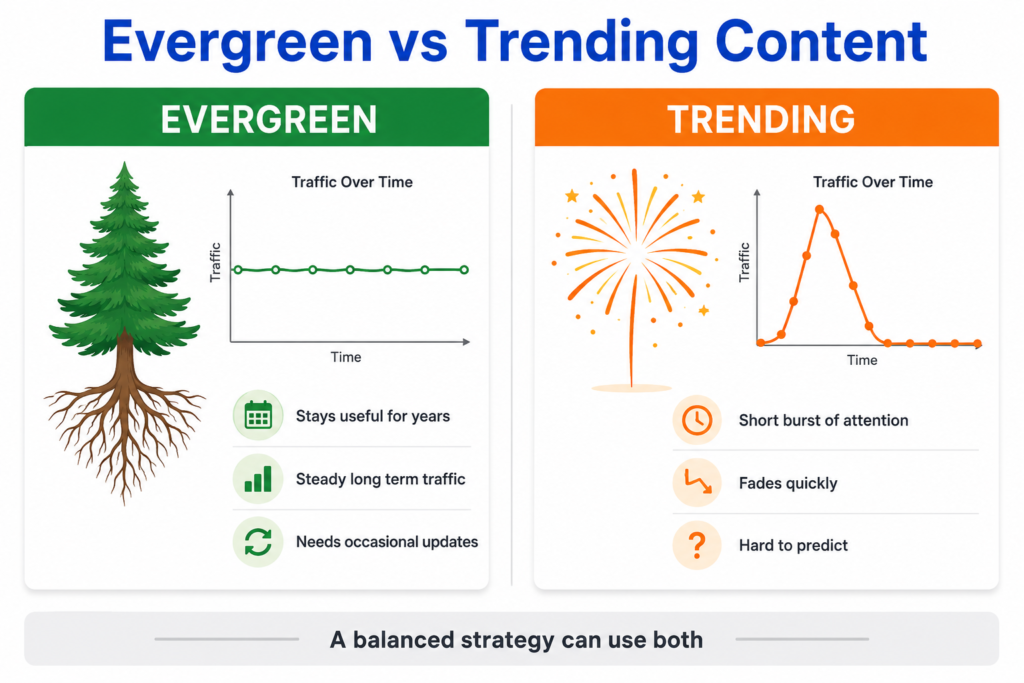
Both have a place. The mistake is treating one as the answer and ignoring the other. Here is how they compare.
| Factor | Evergreen Content | Trending Content |
|---|---|---|
| Lifespan | Stays useful for years | Fades in days or weeks |
| Purpose | Long term traffic and trust | Short term attention and reach |
| Best use | Core questions, how to guides, comparisons | News, launches, seasonal moments |
| Update needs | An occasional refresh to stay current | Rarely worth updating |
| Risk | Slow to gain traction | Disappears fast and is hard to predict |
| Example topic | “How to choose the right X” | “X has just announced Y” |
Trending content is not useless, and evergreen content is not the only thing worth doing. A balanced strategy often uses evergreen content as the steady foundation and adds trending content when something relevant happens in your field. The key is to know which one you are creating and why.
How to Find Evergreen Content Ideas
Finding evergreen ideas is a process, not a guess. Here are the methods that work, roughly in order of value.
Customer questions. These are the best source by far. The questions your customers ask before, during, and after buying are almost always evergreen, because new customers keep asking them. Write these down as they come up.
Google autocomplete and related searches. Start typing a topic into Google and see what it suggests. Scroll to the related searches at the bottom of the results. These show real, repeated demand.
People Also Ask style questions. The questions that appear in the results give you a map of what people want to know around a topic, and they are often phrased exactly as people search.
Question research tools. Tools that gather the questions people ask around a keyword, such as AnswerThePublic, can surface a wide range of evergreen question topics quickly.
Keyword research tools. Tools like Semrush or similar can show search demand and related terms. Use them to confirm interest, but remember that demand is only one signal.
Competitor content gap review. Look at what topics competitors cover well and where they have gaps. A gap on an evergreen topic is an opportunity.
Sales calls and support conversations. The questions that come up again in sales and support are gold, because they reveal the real concerns that block or drive a decision.
Old blog performance review. Look at which of your existing posts keep getting visits over time. Those are already proving themselves evergreen, and they often point to related topics worth covering.
Forum and community questions. Communities and forums in your field show the questions people ask each other, which are often evergreen and honest.
Internal website search data. If your site has a search box, the terms people type into it tell you exactly what they came looking for and could not easily find.
AI tools for brainstorming, with human review. AI tools can help you brainstorm angles and questions quickly. Treat the output as raw ideas to review and validate, not as finished topics. The human judgement is what keeps the quality up.
The strongest ideas usually appear in more than one of these sources. When a question shows up in your support inbox, in autocomplete, and in a community, that is a strong evergreen signal. These strategies for finding new content topics go further into the research side if the ideas are running dry.
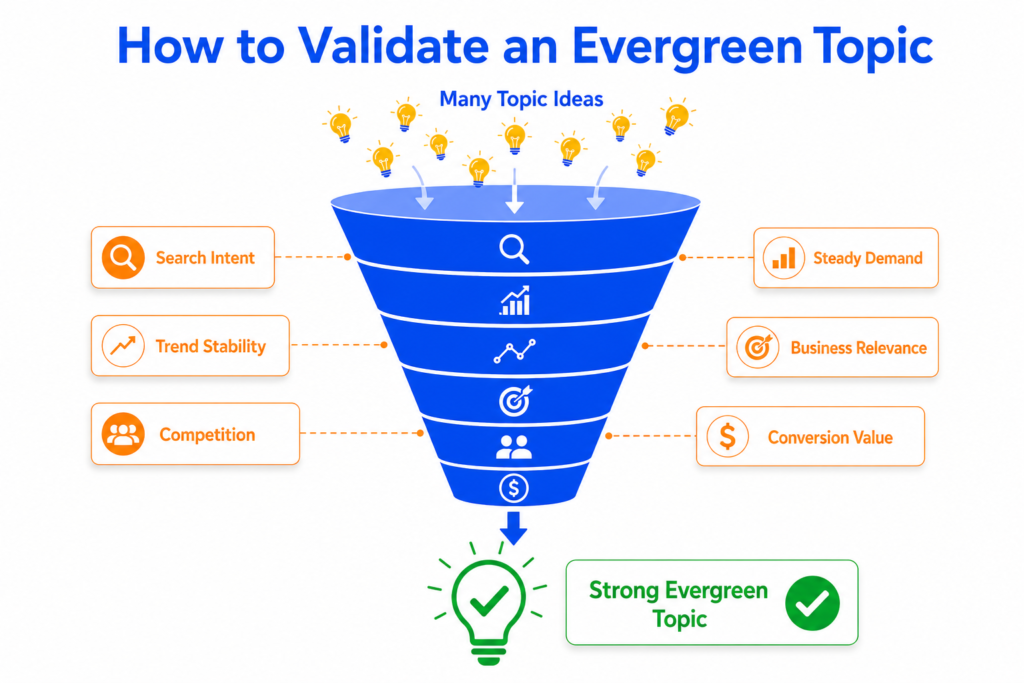
How to Check If a Topic Has Long-Term Value
This is the step most guides skip, and it is the most important. A topic idea is only worth pursuing if it passes a few checks. Run each candidate through these.
Search intent. Do you understand what people actually want when they search for this, and can you satisfy it? If the intent is unclear or you cannot meet it, skip it.
Monthly search demand. Is there steady, repeated interest, rather than a one-time spike? Tools can show this. Some demand is good, but it is not the only factor.
Keyword difficulty. How hard is it to compete for this topic? A very competitive topic may be worth it, but a newer site often does better starting with less crowded ones.
Trend stability. Use a tool like Google Trends to see whether interest is steady over the years or fading. Steady or stable interest is a good evergreen sign.
Business relevance. Does this topic connect to your services, products, or audience? A topic with huge demand but no link to your business is usually not worth it.
Audience pain point. Does it solve a real problem your audience has? The best evergreen topics answer genuine pain points.
Update need. How often will this need updating? Some evergreen topics rarely change, others need regular refreshing. Know what you are signing up for.
Competition quality. Look at what already ranks. If the top results are weak, you have a real chance to do better. If they are excellent, you need a strong angle.
Content depth needed. How thoroughly must you cover this to be genuinely useful? Make sure you can do it justice.
Internal linking opportunity. Does this topic connect naturally to your other pages and services? Topics that fit your wider content and link to your services are more valuable.
Conversion relevance. Does this topic attract people who could become customers, or only casual readers? Both have a place, but topics close to a buying decision tend to be worth more.
A topic that passes most of these is a strong evergreen candidate. One that fails several is probably not worth your time, no matter how high the search volume looks.
Evergreen Content Examples by Business Type
Here are practical topic examples for different kinds of businesses. These are example angles to spark ideas, not guaranteed winners, and they contain no performance claims.
Small business: “How to choose a [service] provider”, a cost guide for your service, common mistakes people make with your service, and a beginner’s guide to your main offering.
Local service business: “How to prepare for a [service] visit”, “signs you need [service]”, a seasonal maintenance checklist, and “what to ask before hiring a [trade]”.
Ecommerce brand: Buying guides, such as “how to choose the right [product]”, product care and maintenance guides, comparisons such as “[option A] vs [option B]”, and “how to use [product]” guides.
B2B service company: “What is [process] and why it matters”, problem and solution explainers, “how to evaluate a [service] partner”, and comparison guides between common approaches.
SaaS company: “How to [achieve the outcome the product helps with]”, step-by-step guides for common tasks, clear definitions and glossaries, and common mistakes in the workflow your product supports.
Personal brand or consultant: Answers to the questions clients ask most often, “how to get started with [topic]”, beginner mistakes in your field, and frameworks you use in your work.
Digital marketing blog: Guides around strategy, SEO basics, content planning, keyword research, and paid ads fundamentals, plus “how to measure [metric]” explainers.
The pattern across all of these is the same. The topics answer repeat questions tied to the business, which is exactly what makes them evergreen.
Evergreen Blog Topics for Small Businesses
For a small business, the best evergreen topics are the ones closest to your customers and your services. You do not need clever ideas. You need the questions your buyers already ask.
A local service business can answer the common questions customers ask before booking, such as how to prepare, what to expect, and how to choose a provider. A small ecommerce store can create buying guides and product care guides that help people decide and then look after what they buy. A consultant can turn the questions clients ask in their first session into evergreen blog posts that answer those same questions for everyone else.
The advantage for small businesses is focus. You do not need hundreds of topics. A focused set of strong evergreen articles, each tied to a service or a real buyer question, will serve you far better than a pile of random posts.
Evergreen Content Ideas for SEO
Evergreen content and SEO fit together naturally, because both reward usefulness that lasts.
Evergreen topics tend to match steady search intent, which is what search engines aim to satisfy. Because the demand is ongoing, a strong evergreen article can keep earning visits over time rather than spiking and fading. And because the topic stays relevant, the page can keep its value with only occasional updates.
For SEO, the most useful evergreen topics are the ones where you can fully answer the query, cover the obvious follow-up questions, and link the article to your related pages and services. That combination of depth, relevance, and internal linking is what helps an evergreen page perform and keep performing.
Keep one thing in mind for 2026. With AI answers now appearing in Search, clear, well-structured, genuinely helpful evergreen content has another advantage. It is the kind of content that can be drawn on as a trusted source, and it tends to win the searches where people still click for the full answer. Optimising your posts for AI Overviews covers what Google has actually confirmed about how those answers pick their sources.
How to Turn Evergreen Ideas Into Helpful Articles
A good evergreen topic still needs a good article. Here is how to do the topic justice.
Answer the main question clearly and near the top, so a reader gets value immediately. Use clear headings that match how people actually ask things, which helps both readers and search engines. Include real examples, because examples turn theory into something people can use. Cover the obvious follow-up questions, since an evergreen reader often has more than one. Add a short set of frequently asked questions to catch the smaller queries. Our on page SEO checklist covers the structure side in detail.
Write from genuine understanding, and add your own experience where you can, because that is what sets your article apart from generic content. Keep the writing clear and free of padding. And plan to update it, since even evergreen content needs the occasional refresh to stay accurate.
Do not target too many keywords in one article. A focused piece that fully answers one topic beats a scattered one that tries to cover everything and satisfies no one.
How to Build an Evergreen Content Strategy
A single evergreen article is good. A connected set of them is far more powerful. This sits inside a wider plan, and the key elements of a content marketing strategy covers the parts that surround the topics themselves. Here is how to build a strategy rather than a pile of posts.
- Start with your core audience problems. List the main problems and questions your audience has, because these are the roots of your evergreen topics.
- Group topics into clusters. Cluster related topics around a main subject, so they support each other and show depth.
- Create one strong pillar article. For each cluster, write a thorough pillar that covers the main subject well.
- Support it with smaller articles. Add focused posts that each answer a related question and point back to the pillar.
- Link related articles together. Internal links help readers move between your pieces and help search engines understand how they connect.
- Refresh articles regularly. Review your evergreen content every few months and update facts, examples, and advice.
- Track useful actions, not only page views. Measure enquiries, signups, and other real actions, so you know which content actually helps the business.
- Add examples and FAQs. These make each piece more useful and help cover related questions.
- Avoid thin content. A few strong pieces beat many weak ones. Quality is what keeps evergreen content working.
Once you have the topics, our content calendar generator turns them into a schedule you can actually keep.
Common Mistakes When Choosing Evergreen Topics
These mistakes waste effort and lead to content that never delivers. Avoid them.
- Choosing topics only because they have high search volume, while ignoring relevance and intent
- Ignoring search intent and writing something that does not match what people want
- Writing generic AI content with nothing original added
- Copying competitor topics without adding anything more useful
- Choosing topics unrelated to your business, which attract the wrong audience
- Publishing and never updating, so the content slowly goes stale
- Confusing evergreen with basic, and writing shallow posts that do not go deep enough to be useful
- Using weak titles that do not match how people search or fail to draw a click
- Ignoring internal links, leaving articles stranded with nothing pointing to them
- Not adding practical examples, so the content stays abstract and forgettable
- Targeting too many keywords in one article, so it covers everything lightly and nothing well
Practical Evergreen Content Checklist
Run each topic and article through this before you commit.
- A clear audience need behind the topic
- Long-term relevance, so the need will still exist in a few years
- A clear match to search intent
- Real relevance to your business
- Useful examples included
- A clear answer near the start
- Helpful headings that match real questions
- The keyword used naturally, not stuffed
- Internal links planned to related pages and services
- External trusted sources cited where useful
- An original explanation in your own words
- No copied content
- No fake claims or invented numbers
- A plan to refresh the article over time
- A short FAQ section for related questions
- A clear next step for the reader
Frequently Asked Questions
Helpful Resources
Source: Google Search Central. Google’s core guidance on building content that can appear in Search, including helpful, people-first content. A reliable foundation for evergreen content that aims to rank.
Search Quality Rater Guidelines (PDF)
Source: Google. The document Google’s raters use to judge quality, including experience, expertise, authoritativeness, and trust. Useful for understanding what makes content genuinely high quality and lasting.
Source: Google. The help centre for Google Search Console, where you can see which of your pages and searches bring steady traffic over time, which helps you spot what is already evergreen.
Source: Google. Help for Google Trends, the tool that shows whether interest in a topic is steady or fading over time. Useful for checking the trend stability of an evergreen candidate.
Source: Semrush. Documentation for Semrush’s keyword and content tools, useful when researching demand and related terms for potential evergreen topics.
AnswerThePublic
Source: AnswerThePublic. A question research tool that gathers the questions people ask around a keyword, helpful for surfacing evergreen question-based topics quickly.
Conclusion
Evergreen content is the steady foundation that most strong content strategies are built on. The topics stay useful for years because the needs behind them do not go away. The skill is not just writing them. It is identifying which topics are genuinely evergreen and worth your time.
Use the method in this guide to find ideas from the questions people actually ask, then run each one through the validation checks before you commit. Focus on topics tied to your business and your audience’s real problems, write articles that fully answer the question, and refresh them as needed.
Evergreen content does not always rank, and it is never instant. But built on the right topics, with patience and quality, it becomes content that keeps working long after you publish it. Start with one strong evergreen topic, do it well, and build from there.