

Quick Answer
What are the key elements of a successful content marketing strategy? The core elements are a clear business goal, a defined audience, real search intent, focused topics and topic clusters, the right content formats, a content calendar, quality standards, a distribution plan, SEO and internal linking, trust signals, performance tracking, and a habit of updating old content. Together, these turn scattered content into a system that supports your business.
Why do these elements matter? Because content marketing is not just about publishing posts. Each element connects what your audience needs to what your business wants, then makes sure the content is found, trusted, and measured. Skip the elements, and you get busy work with no results.
What should a beginner focus on first? Start small. Pick one clear audience, set one goal, build strong service pages, and answer the real questions your customers ask. Quality and consistency beat volume.
How is content marketing different in 2026? Search now includes AI answers, so clear, trustworthy, genuinely helpful content matters more than ever. Thin or mass-produced content is riskier, and real experience and trust carry more weight.
Introduction
Most content marketing fails for a simple reason. Someone publishes blog posts with no plan behind them, then wonders why nothing happens. The posts are not tied to a goal, not aimed at a real audience, and never reach anyone after they go live.
A successful content marketing strategy is different. It is a connected system where audience needs, business goals, useful content, distribution, and measurement all work together. This guide breaks down the elements of that system and shows you how to build one, in plain language, for 2026. No fake statistics, no hype, and no promises that content marketing always works.
What Is a Content Marketing Strategy?
A content marketing strategy is your plan for creating and sharing useful content that attracts the right people and moves them toward becoming customers. It is the thinking that sits behind the content, not the content itself.
The difference matters. Publishing blog posts is an activity. A strategy is the system that decides what to create, who it is for, why it exists, where it goes, and how you know if it worked. Without that system, content is just noise. With it, every piece has a job.
A simple way to picture it: content marketing connects three things. What your audience needs, what your business wants to achieve, and the content that bridges the two. The strategy is how you keep those three aligned over time.
Why a Content Marketing Strategy Matters in 2026
Content without a strategy wastes time and money, and in 2026, the cost of getting it wrong is higher.
Search has changed. AI answers now appear at the top of many results, which means clear, trustworthy, genuinely helpful content is rewarded, while thin and generic content is more likely to be ignored. Publishing lots of low-value posts, including mass-produced AI content with nothing original added, is riskier than ever.
At the same time, the opportunity is real. People still search for answers before they buy, on Google and increasingly in tools like ChatGPT, Claude, and Gemini. A business that consistently answers those questions well becomes the trusted source. That is what a strategy helps you do on purpose, rather than by accident.
The honest caveat is that content marketing does not always work, and it is never instant. It works when the strategy is sound, the content is genuinely useful, and you give it time.
Key Elements of a Successful Content Marketing Strategy
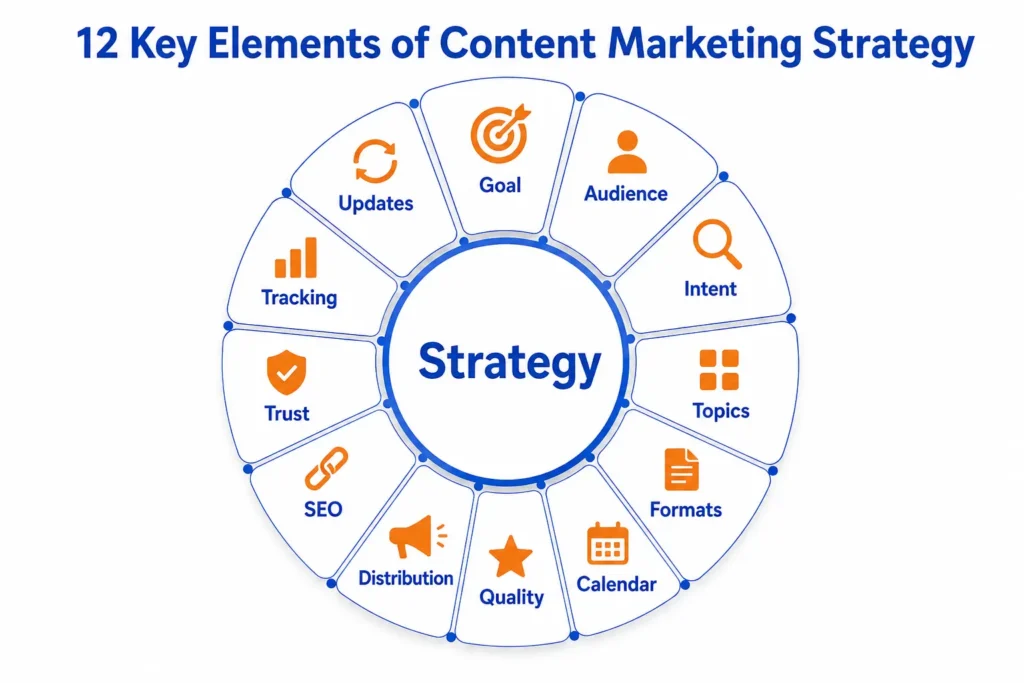
Here are the elements that turn scattered content into a working system. For each one, you get what it means, why it matters, how to apply it, a simple example, and a common mistake to avoid.
Clear Business Goal
What it means: The specific business outcome your content is meant to support, such as more enquiries, more sales, or more email signups.
Why it matters: Without a goal, you cannot tell whether content is working, and you end up creating things that look busy but lead nowhere.
How to apply it: Pick one or two clear goals before you create anything. Tie every piece of content to a goal, even loosely.
Example: A local service business sets the goal of more booked jobs, so its content focuses on service pages and local guides that lead to enquiries.
Mistake to avoid: Writing content with no goal in mind, then measuring success by vanity numbers like page views that do not affect the business.
Defined Audience
What it means: A clear picture of who you are creating content for, including their problems, questions, and situation.
Why it matters: Content written for everyone connects with no one. Knowing your audience lets you write things that actually resonate.
How to apply it: Describe your main audience in plain terms. What do they want, what are they worried about, and what do they search for?
Example: A coach defines their audience as new managers struggling with their first team, so every post speaks directly to that person.
Mistake to avoid: Trying to appeal to everyone, which produces vague content that helps no one in particular.
Search Intent
What it means: Understanding what a person actually wants when they type a query, not just the words they use.
Why it matters: If your content does not match intent, it will not satisfy the reader or rank well, no matter how many keywords it contains.
How to apply it: Before writing, search the query yourself and look at what already ranks. Notice whether people want a definition, a how-to, a comparison, or a product. Then match that.
Example: A small ecommerce store notices people searching for a product term want a buying guide, not a sales page, so it creates a helpful comparison guide instead.
Mistake to avoid: Writing for the keyword while ignoring what the searcher actually came to do.
Content Topics and Topic Clusters
What it means: Choosing the right topics and grouping related content around a main subject.
Why it matters: Clusters help readers go deeper and help search engines see that you cover a subject thoroughly, which builds topical authority.
How to apply it: Pick a few core topics tied to your business. For each, create one main pillar page and several supporting posts that link to it. If the topics themselves are the bottleneck, these strategies for finding new content topics cover where fresh angles actually come from.
Example: A SaaS company builds a cluster around one problem its product solves, with a pillar page and supporting posts that each answer a related question.
Mistake to avoid: Publishing random, unconnected topics that never build depth or authority on anything.
Content Formats
What it means: The forms your content takes, such as blog posts, service pages, guides, videos, emails, and social posts.
Why it matters: Different people prefer different formats, and the same idea can work across several, which stretches your effort further.
How to apply it: Choose formats that fit your audience and your strengths. You do not need all of them. Pick a few you can do well.
Example: A consultant answers common client questions through short blog posts and short videos, reusing the same ideas in both.
Mistake to avoid: Spreading yourself across every format and platform and doing all of them poorly.
Content Calendar
What it means: A simple plan for what you will publish and when.
Why it matters: A calendar turns good intentions into consistent output, and consistency is what builds momentum over time.
How to apply it: Plan a realistic schedule you can actually keep, even if that is one strong piece a week or a fortnight. Note the topic, format, and goal for each. Our content calendar generator turns your topics and posting frequency into a schedule you can work from.
Example: A small business plans two useful posts a month, each tied to a service, rather than promising daily content it cannot sustain.
Mistake to avoid: Setting an unrealistic schedule, burning out, and then publishing nothing for months.
Content Quality Standards
What it means: The bar every piece must meet before it goes live, covering usefulness, accuracy, clarity, and originality.
Why it matters: In 2026, quality is the difference between content that helps you and content that drags your site down.
How to apply it: Write a short standard. Every piece must answer the question clearly, be accurate, include real insight or experience, and read well. If it does not meet the bar, fix it or do not publish.
Example: A B2B service company insists every post solves a specific client problem with practical detail, not generic advice.
Mistake to avoid: Publishing thin or generic content, including unedited AI output, to keep a schedule.
Distribution Plan
What it means: How your content reaches people after you publish it.
Why it matters: Content that is published but never shared usually goes unseen. Distribution is often the missing half of content marketing.
How to apply it: Decide where each piece goes after publishing, such as email, social media, or relevant communities. Repurpose key points into smaller posts.
Example: A coach turns each blog post into a few short social posts and includes it in a monthly email to their list.
Mistake to avoid: Treating publishing as the finish line and doing nothing to get the content in front of people.
SEO and Internal Linking
What it means: Making your content easy for search engines to find and understand, and connecting related pages with internal links.
Why it matters: SEO brings people to your content over time, and internal links help both readers and search engines move through your site.
How to apply it: Target real search intent, use clear titles and headings, and link related posts to each other and to your service pages. Make sure your pages can be crawled and indexed. Our on page SEO checklist covers each of those elements in detail.
Example: An ecommerce store links its buying guides to the relevant product and category pages, so readers can act on what they learn.
Mistake to avoid: Publishing orphan pages that nothing links to, or stuffing keywords instead of writing clearly. An orphan page can sit indexed but never ranking indefinitely, which is one of the quietest ways content effort gets wasted.
Trust and E-E-A-T Signals
What it means: Showing that real, capable people stand behind your content. Google describes this as experience, expertise, authoritativeness, and trust, often shortened to E-E-A-T.
Why it matters: Trust influences both whether people believe your content and how search engines judge its quality.
How to apply it: Add real author or business details, a clear About page, accurate information, and proof such as reviews where relevant. Show genuine experience in the content.
Example: A consultant publishes posts under their own name with a short bio explaining their background, so readers know who is talking.
Mistake to avoid: Anonymous, generic content with no sign of who created it or why they can be trusted.
Performance Tracking
What it means: Measuring whether your content is achieving the business goal you set.
Why it matters: Without tracking, you cannot tell what is working, so you cannot improve or justify the effort.
How to apply it: Track real business actions, such as enquiries, calls, form submissions, and email signups, not just page views. Use tools like Google Analytics and Google Search Console.
Example: A local business tracks how many calls and form fills come from its service pages and guides, not just how many people visited.
Mistake to avoid: Measuring only traffic and celebrating visits that never turn into customers.
Content Updates
What it means: Keeping your existing content accurate and useful over time.
Why it matters: Content goes stale. Advice changes, tools change, and an out-of-date page can quietly lose trust and rankings.
How to apply it: Review your important pages every few months. Update facts, refresh examples, and improve weak posts rather than always chasing new ones. Some topics need this far less often than others, and knowing which of your topics are genuinely evergreen tells you where the effort pays back.
Example: A SaaS company updates its product education posts whenever the product changes, so the content stays correct.
Mistake to avoid: Publishing and forgetting, leaving old pages to drift out of date.
How to Create a Content Marketing Strategy Step by Step
Here is a practical order to build your strategy. You do not need to do it all at once, but this sequence keeps the pieces connected.
Step 1: Define the business goal. Decide what you want the content to achieve, such as more enquiries or sales. Everything else serves this.
Step 2: Understand the audience. Get clear on who you are helping, their problems, and the questions they ask.
Step 3: Map the buyer journey. Think about the stages a customer goes through, from first noticing a problem to choosing a solution, and what they need at each stage.
Step 4: Research search intent. For the topics you are considering, look at what people actually want when they search, and what already ranks.
Step 5: Choose content topics. Pick topics tied to your business and your audience’s real questions, not random ideas.
Step 6: Build topic clusters. Group related topics around a main pillar, with supporting posts that link to it.
Step 7: Choose content formats. Decide which formats fit your audience and your strengths, and start with a few you can do well.
Step 8: Create a content calendar. Plan a realistic schedule with topic, format, and goal for each piece.
Step 9: Set quality standards. Write a short bar that every piece must clear before publishing.
Step 10: Plan distribution. Decide how each piece reaches people after it goes live.
Step 11: Track performance. Set up tracking for real business actions, then review it regularly.
Step 12: Update old content. Build a habit of refreshing existing pages, so they stay accurate and useful.
This does not guarantee results, but it gives you a connected system instead of a scattered effort.
Content Marketing Strategy for Small Businesses
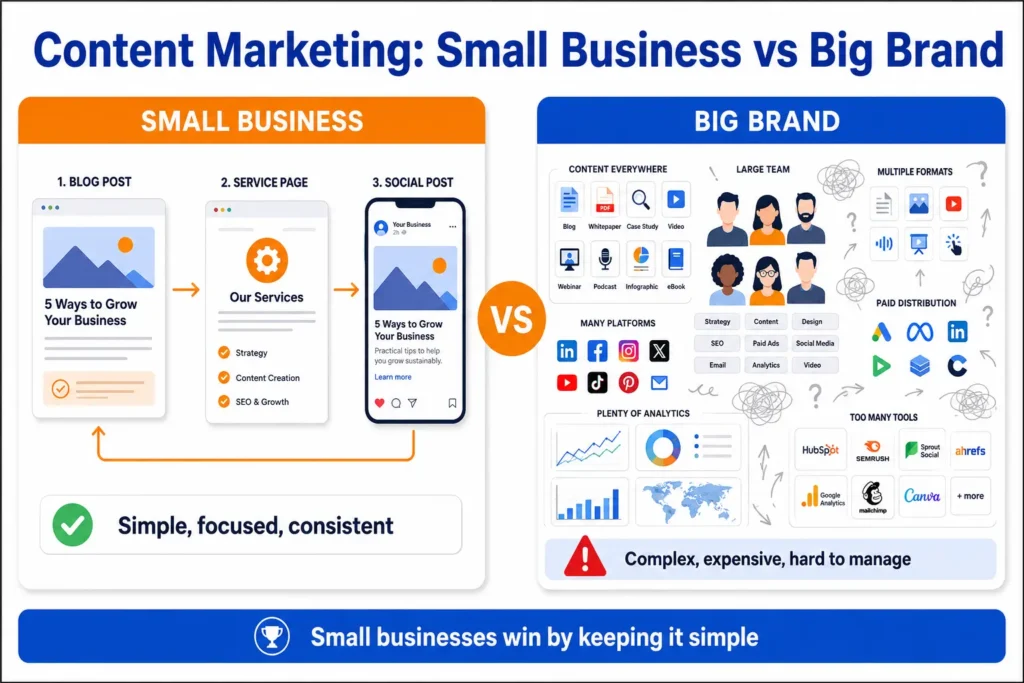
Small businesses often think they need to do what big brands do. They do not. In fact, trying to do too much is a common reason small business content fails. Keep it simple and focused.
Focus on one clear audience rather than trying to reach everyone. Build your service pages first, because those are the pages closest to a sale. Answer the real questions your buyers ask, in plain language. Use local proof where relevant, such as reviews and local details, if you serve an area.
Create fewer but better articles. A handful of genuinely useful pieces will do more than a flood of thin ones. Repurpose what you create for social media so each piece works harder. Build internal links so readers move from a helpful post to the service that solves their problem.
Track the things that matter to a small business: calls, form submissions, email signups, and enquiries. Do not chase every trend, and do not publish thin AI content to fill a calendar. Consistency and quality, kept simple, beat complexity every time. Whether SEO is still effective for a small business covers how that consistency compounds over time.
Content Marketing Strategy for SEO
Content and SEO work best together. Content gives search engines something worth ranking, and SEO helps the right people find that content. Here is how they connect.
Search intent is the foundation. Content that matches what people actually want is what ranks and satisfies readers. Keywords alone do not.
Topic clusters help because covering a subject thoroughly, with a pillar page and supporting posts, signals depth and helps you rank for a range of related searches.
Internal links matter because they help search engines discover and understand your pages, and they guide readers to the next useful step.
Helpful content matters because search engines aim to reward content that is genuinely useful and made for people, not for the algorithm.
Content updates matter because fresh, accurate content holds its value, while stale content can slip.
Author and business trust signals matter because they support the experience and trust that search engines look for.
Finally, content should answer the full query clearly. A page that fully and directly answers what someone asked, including the obvious follow-up questions, serves both readers and search engines and is more likely to be used by AI answers, too. Optimising your posts for AI Overviews covers what Google has actually confirmed about how those answers pick their sources.
Common Content Marketing Mistakes
These are the patterns that waste effort again and again. Avoiding them puts you ahead of most.
- Writing without a clear goal, so the content leads nowhere
- Writing for keywords instead of for readers
- Publishing random, unconnected topics
- Ignoring search intent and missing what people actually want
- Creating thin AI content with nothing original added
- Never updating old content
- Having no distribution plan, so the content goes unseen
- Measuring only traffic instead of real business actions
- Ignoring internal links and leaving pages stranded
- Publishing too much low quality content in a rush for volume
- Copying competitors without adding anything more useful
- Buying tools and expecting them to replace an actual strategy
Practical Content Marketing Checklist
Work through this as you build and run your strategy.
- A clear business goal
- A defined target audience
- Your audience’s real pain points
- Search intent research for your topics
- Topic clusters around core subjects
- Chosen content formats you can do well
- A realistic content calendar
- Written editorial standards
- Original examples and real experience in your content
- Genuinely helpful answers to real questions
- A clear SEO title and meta description for each piece
- Internal links between related pages
- A strong introduction that answers quickly
- A clear call to action
- A distribution plan for each piece
- Performance tracking for real business actions
- A content refresh plan for old pages
- Trust signals across your site
- Real author or business details
Frequently Asked Questions
Helpful Resources
Source: Google Search Central. Google’s core guidance on building content that can appear in Search, including the basics of helpful, people first content. A reliable foundation for the SEO side of your strategy.
Search Quality Rater Guidelines (PDF)
Source: Google. The document Google’s raters use to judge quality, including experience, expertise, authoritativeness, and trust. The clearest description of what high quality content looks like.
Source: Content Marketing Institute. A long running, respected resource for content marketing guidance, research, and best practices across industries.
American Marketing Association
Source: American Marketing Association. A credible source for marketing fundamentals, definitions, and professional guidance.
Source: Google. Official help for setting up and using Google Analytics so you can measure real actions rather than just traffic.
Source: Google. The help centre for Google Search Console, where you check indexing, submit a sitemap, and see which searches bring people to your content.
Conclusion
A successful content marketing strategy is not a pile of blog posts. It is a connected system that links what your audience needs to what your business wants, then makes sure the content is found, trusted, and measured.
You do not need to do everything at once. Start with a clear goal and a defined audience, build strong pages that answer real questions, distribute what you create, and track the actions that matter. Keep the quality high and the focus tight, especially if you are a small business.
Content marketing does not always work, and it is never instant. But built on these elements, with patience and consistency, it becomes one of the most durable ways to grow. Start with the basics, serve your audience honestly, and improve as you go.