
Quick Answer
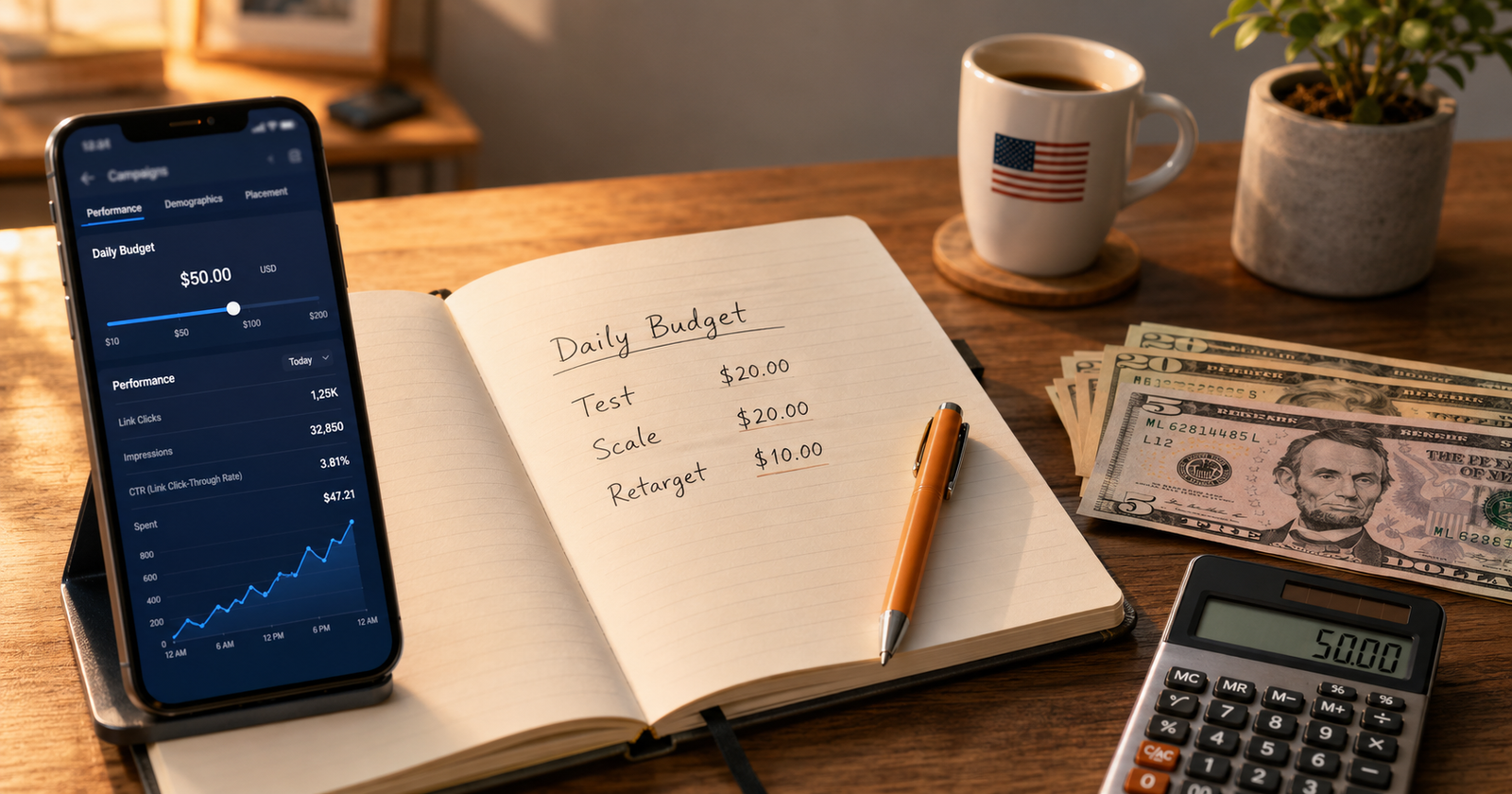
What is a good daily budget for Facebook ads in the USA? There is no single perfect number. A reasonable starting range for most small businesses in the USA is 10 to 30 dollars a day for testing and learning. For serious lead generation or ecommerce, 30 to 50 dollars a day or more is usually needed to collect enough data for meaningful decisions. The right budget depends on your goal, your industry, your offer, and what you are trying to learn.
What is the recommended daily budget for Facebook ads targeting US audiences? For a focused test with one campaign and one or two creatives, 10 to 20 dollars a day can work. For lead generation, where the average cost per lead in the USA sits around 25 to 30 dollars, you need enough daily budget to generate at least a few leads per week, which usually means 20 to 50 dollars a day or more.
What is a typical daily budget for small businesses running Facebook ads in the USA? Many small businesses start in the 10 to 25-dollar range. Local businesses with tight geographic targeting can often start at the lower end, while ecommerce stores testing cold audiences usually need the higher end to get meaningful data.
How much should I spend daily on Facebook ads to get a good ROI in the USA? ROI depends far more on your offer, creative, landing page, and tracking than on the budget number itself. A bigger budget on a weak setup wastes money faster. Start small, get the fundamentals right, and increase only when you see results you can sustain.
Introduction
Choosing a daily budget is one of the first decisions you make in Ads Manager, and it is one of the most confusing. Too low and the system cannot learn. Too high and you burn through money before you know what works.
This guide helps you choose a daily budget that matches your actual goal, with real cost context for the USA in 2026: no invented numbers, no fake case studies, and no promises of guaranteed results.
What Is a Good Daily Budget for Facebook Ads in the USA?
A good daily budget gives the ad system enough room to learn while matching what you can afford to test. That answer changes depending on your business.
For a local service business running awareness or lead ads in a small area, 10 to 15 dollars a day can be a reasonable test. For an ecommerce store testing a cold audience nationally, 25 to 50 dollars a day is usually the minimum for the system to find enough buyers to learn from. For a B2B company running lead generation in a competitive vertical, 30 to 50 dollars a day or more is often needed because the cost per lead tends to be higher.
These are starting ranges for testing, not permanent budgets. The real answer always comes from your own data after you run for a while. Before you commit, you can estimate what a given daily budget is likely to deliver in reach, clicks, and leads, so the starting number is at least an informed one.
What Is the Recommended Daily Budget for Facebook Ads Targeting US Audiences?
US audiences are among the most expensive to reach on Meta. Based on 2026 benchmark reports from sources like WordStream, Triple Whale, and Databox, CPM (cost per thousand impressions) in the USA sits in the 11 to 16 dollar range for most objectives, with awareness campaigns typically at the lower end, and can go higher in competitive industries. CPC for traffic campaigns averages around 0.70 dollars, while lead generation CPC averages around 1.92 dollars. The average cost per lead for lead ads is reported at around 27.66 dollars.
What this means for your daily budget is straightforward. At a 0.70 dollar CPC, 10 dollars a day gives you about 14 clicks. At a 1.92 dollar CPC, it gives you about 5. At a 27.66 dollar average cost per lead, you may not even get one lead per day at 10 dollars.
So for US audiences, the recommended starting budget depends on your objective. Traffic and awareness tests can work at 10 to 15 dollars a day. Lead generation usually needs 20 to 50 dollars a day to generate useful data. Ecommerce conversion campaigns often need 30 to 50 dollars or more per day because the system needs enough purchase events to exit the learning phase.
These are general benchmark ranges, and they vary by industry, audience, creative, and season. Use them to plan, not as guarantees.
What Is a Typical Daily Budget for Small Businesses in the USA?
Most small businesses in the USA start with somewhere between 10 and 30 dollars a day. Local businesses with tight geographic targeting tend to sit at the lower end because their audience is small and the reach is cheaper. Ecommerce businesses testing products to a national audience tend to sit at the higher end because they need more data from a larger pool.
The key insight is that the budget itself is not what makes ads work. A 10-dollar daily budget with a strong offer, a clear audience, and good creative can outperform a 50-dollar budget with a vague offer and a weak landing page. The budget determines how fast you collect data.
That is why the more useful question is not how much, but what a given budget can realistically buy you. We broke that down in detail for whether 10 dollars a day is enough for Facebook ads.
How Much Should I Spend Daily on Facebook Ads to Get a Good ROI?
There is no daily budget number that guarantees ROI. This is worth being direct about, because it is the most common misconception beginners have.
ROI comes from the combination of your offer, your creative, your landing page, your tracking, and your audience. The budget determines how quickly you can test those things and find what works. A bigger budget on a broken funnel loses money faster.
A practical way to think about it is to work backwards. If your product sells for 50 dollars and a typical cost per purchase on Facebook is in the 30 to 40 dollar range (which aligns with 2026 ecommerce benchmarks), you need to know whether that margin works for your business before you set the budget. If it does, set a daily budget that allows the system to generate a few purchases per week so it can learn and optimise. Working out the break even ROAS for your product tells you whether that cost per purchase is survivable at all, which is a better starting point than picking a budget and hoping.
Daily Budget by Campaign Goal
Not every campaign needs the same budget. Here is a practical breakdown by goal.
Awareness campaigns
When it makes sense: You want people in your area or audience to see your brand.
What a small budget can test: Whether your ad resonates enough to generate impressions cheaply.
What a small budget cannot prove: Whether awareness leads to sales later.
What to watch: CPM (cost per thousand impressions) and reach. A CPM in the 7 to 15 dollar range is normal for US awareness campaigns in 2026.
Starting budget: 5 to 15 dollars a day is often enough.
Traffic campaigns
When it makes sense: You want clicks to a page so you can test the offer or build pixel data.
What a small budget can test: Whether people click, and which creative drives the most clicks.
What a small budget cannot prove: Whether clicks turn into leads or sales (that depends on the page).
What to watch: CPC (cost per click) and CTR (click through rate). A CPC of around 0.50 to 1.00 dollars is competitive for US traffic campaigns.
Starting budget: 10 to 20 dollars a day.
Lead generation campaigns
When it makes sense: You need enquiries, form fills, or sign-ups.
What a small budget can test: Whether your offer generates leads, and at what cost.
What a small budget cannot prove: Lead quality at scale. A few leads are not enough to judge whether they convert into customers.
What to watch: Cost per lead and lead quality after the form. The 2026 US average cost per lead for Facebook lead ads is around 27.66 dollars, but this varies hugely by industry.
Starting budget: 20 to 50 dollars a day. Below 20 dollars, the lead data comes in too slowly.
Message campaigns
When it makes sense: You want people to message you on WhatsApp, Messenger, or Instagram.
What a small budget can test: Whether your ad starts conversations.
What a small budget cannot prove: Whether conversations turn into paying customers.
What to watch: Cost per messaging conversation and reply rate.
Starting budget: 10 to 20 dollars a day.
Sales campaigns
When it makes sense: You want purchases on your online store.
What a small budget can test: Whether your product and page convert from ad traffic.
What a small budget cannot prove: Scalability. The system needs around 50 conversion events per ad set per week to exit the learning phase, and at a low budget, that threshold is hard to reach for purchase events.
What to watch: Cost per purchase, return on ad spend (ROAS), and add to cart rate.
Starting budget: 30 to 50 dollars a day or more. Below this, purchases come in too slowly for the system to optimise well.
Retargeting campaigns
When it makes sense: You want to re-engage people who have already visited your site, watched a video, or engaged with your page.
What a small budget can test: Whether warm audiences convert at a lower cost.
What a small budget cannot prove: Long-term reach, because retargeting audiences are small and get saturated.
What to watch: Frequency, cost per result, and whether results keep flowing or start to dry up.
Starting budget: 5 to 15 dollars a day. Retargeting audiences are small, so a large budget is not needed and can cause ad fatigue.
Facebook Ads Daily Budget for Lead Generation
Lead generation deserves its own section because it is where budget mistakes hurt the most.
If your cost per lead is around 25 to 30 dollars and your daily budget is 10 dollars, you may get one lead every two or three days. That is not enough data to judge creative quality, offer strength, or audience fit. You end up guessing instead of deciding. Once you have a week or two of spend behind you, calculate your actual cost per lead rather than planning against the national average, because industry variation on this number is wide.
A daily budget of 20 to 50 dollars gives you a few leads per week, which is enough to start seeing patterns. More importantly, you need to track what happens after the lead. A cheap lead that never answers the phone is not good. Build lead quality tracking into your process from the start.
For competitive industries like real estate, financial services, or B2B, cost per lead can be significantly higher than the average, which means you may need 50 dollars a day or more to test properly.
Facebook Ads Daily Budget for Ecommerce
Ecommerce campaigns face a different challenge. Meta’s system needs purchase events to learn, and purchases happen less often than clicks or leads. If your product costs 40 dollars and your cost per purchase is around 30 to 35 dollars, a 10-dollar daily budget may not generate a single purchase for days.
Meta’s own guidance says the system needs roughly 50 conversion events per ad set per week to exit the learning phase. At a 30-dollar cost per purchase, that would require 1,500 dollars per week, or about 214 dollars per day per ad set. Most small businesses cannot afford that.
The practical workaround is to optimise for a higher funnel event, like add to cart or initiate checkout, which happens more often and costs less. This lets the system learn even on a smaller budget. Then, once you have enough data, you can shift to optimising for purchases.
A realistic starting budget for a small ecommerce store testing one product is 20 to 50 dollars a day.
The budget only works if the setup underneath it is right, and how to structure a Meta Ads campaign for ecommerce covers the Pixel, catalog, and objective decisions that come first.
Affordable Facebook Ads Budget Options for US Businesses
If money is tight, here are three honest approaches.
Option 1: Test first, then decide. Start at 10 to 15 dollars a day with one focused campaign. Give it 7 to 14 days. If you see promising signals, increase. If not, fix the offer, creative, or landing page before spending more.
Option 2: Focus on retargeting only. If you already get some traffic from organic search, social, or other sources, run a retargeting campaign at 5 to 10 dollars a day. This is often the highest return use of a tiny budget because the audience is already warm.
Option 3: Run a short burst. Instead of a low daily budget spread over months, concentrate your budget into a focused 2 to 4 week test at a higher daily rate. 300 dollars spread over 14 days at roughly 21 dollars a day gives the system more to work with than 300 dollars spread over 30 days at 10 dollars.
If you are planning a burst like this, it helps to turn a total budget into a daily figure across different test lengths so you can see the tradeoff clearly.
Factors That Influence Facebook Ads Daily Budget in the USA
Your ideal daily budget is shaped by several things, and understanding them helps you plan better.
Industry. Some industries are more expensive than others. Finance, insurance, and legal services have higher CPCs and CPLs. Food, apparel, and entertainment tend to be cheaper.
Campaign objective. Awareness is the cheapest. Conversion and purchase campaigns cost more per result because Meta targets higher-intent users.
Audience size and targeting. Very narrow audiences can be more expensive per impression. Very broad audiences may waste budget on irrelevant people.
Creative quality. Better ads get rewarded with lower costs in Meta’s auction. Poor creative increases your CPC and CPM. If producing multiple variations is the bottleneck, Meta’s automated creative tools can generate them for you.
Landing page quality. A slow or irrelevant page means fewer conversions, which means a higher cost per result.
Season. Q4 is the most expensive period in the USA. CPMs can run 15 to 40 percent above the annual average during the holidays.
Competition. More advertisers targeting the same audience drives prices up.
Tracking. Without proper pixel and conversion setup, the system cannot optimise delivery, which wastes budget. Getting conversion tracking right is worth doing before you spend anything at all.
How to Know If Your Daily Budget Is Too Low
There are a few signals that your budget is too small for what you are asking it to do.
Your ad set stays in the learning phase for more than two weeks. Your cost per result is unstable and swings wildly from day to day. You are getting fewer than a handful of conversion events per week. Meta shows a warning that your budget may limit delivery. You do not have enough results after two weeks to make a confident decision.
If you see these signals, you have three options. Increase the budget, simplify the campaign structure (fewer ad sets so each one gets more spend), or move your optimisation event higher up the funnel (optimise for add to cart instead of purchase, for example).
When to Increase Your Facebook Ads Budget
Increase only when these conditions are met.
You have at least one creative performing at a cost per result you can sustain. Your tracking is working, and you trust the data. Your landing page is converting. You have run for at least 7 to 14 days at the current level. You have a clear picture of your cost per lead, cost per purchase, or cost per result.
When you increase, do it gradually—roughly 20 percent at a time. Large jumps can reset the learning phase and spike your costs for several days while the system recalibrates.
Common Mistakes With Small Facebook Ads Budgets
Choosing a budget before choosing a goal. The goal should determine the budget, not the other way around.
Expecting ROI too fast. A few days is not enough data for most objectives.
Running too many ad sets on a small budget. Each one gets a tiny share and learns nothing.
Changing the campaign every few hours. Constant edits reset the learning process.
Using weak creative and expecting the budget to compensate. It cannot.
Using a vague offer that does not give the viewer a reason to act.
Sending traffic to a slow, confusing, or irrelevant landing page.
Choosing the wrong campaign objective, like optimising for traffic when you actually need leads.
Ignoring pixel or conversion tracking, so you cannot measure what matters.
Judging performance by clicks alone instead of real business actions.
Ignoring lead quality and celebrating cheap leads that never become customers.
Increasing the budget before fixing the creative, offer, or landing page.
Two Real World Examples
Example 1: Local service business in the USA
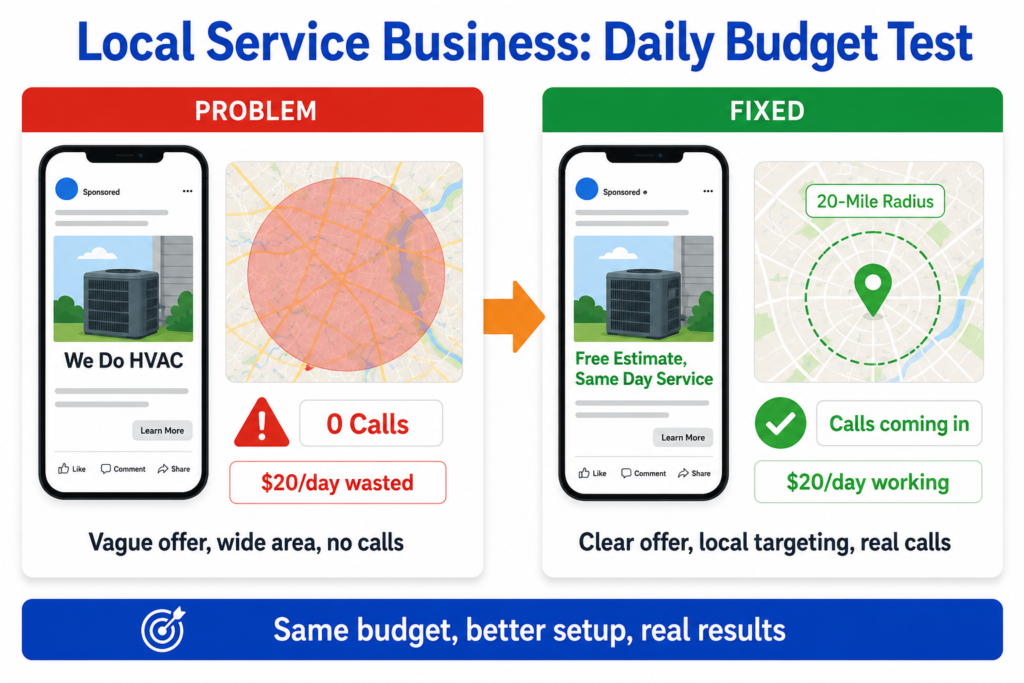
What the business wants: A local HVAC repair company in Texas wants more service calls from homeowners within a 20-mile radius.
What daily budget could make sense for testing: 15 to 20 dollars a day. The audience is small and local, so the budget does not need to be large.
What result signals to watch: Cost per lead, number of actual phone calls or messages, and whether enquiries are from homeowners in the service area. Track what happens after the lead, not just the form fill.
What can go right: With tight local targeting and a clear offer like “same day service” or “free estimate,” the business can get local visibility and a few real enquiries per week at this budget.
What can go wrong: If the offer is vague, if the targeting is too wide, or if nobody answers the phone when leads call, the budget is wasted. A generic “we do HVAC” ad with no clear reason to act will underperform.
When to increase the budget: When leads are consistently turning into booked jobs, and the cost per booked job makes sense financially.
When to stop and fix the campaign: When leads are not converting into calls, when the cost per lead is climbing, or when the quality of enquiries is poor. Fix the offer, the form, or the landing page first.
Example 2: Small ecommerce store in the USA
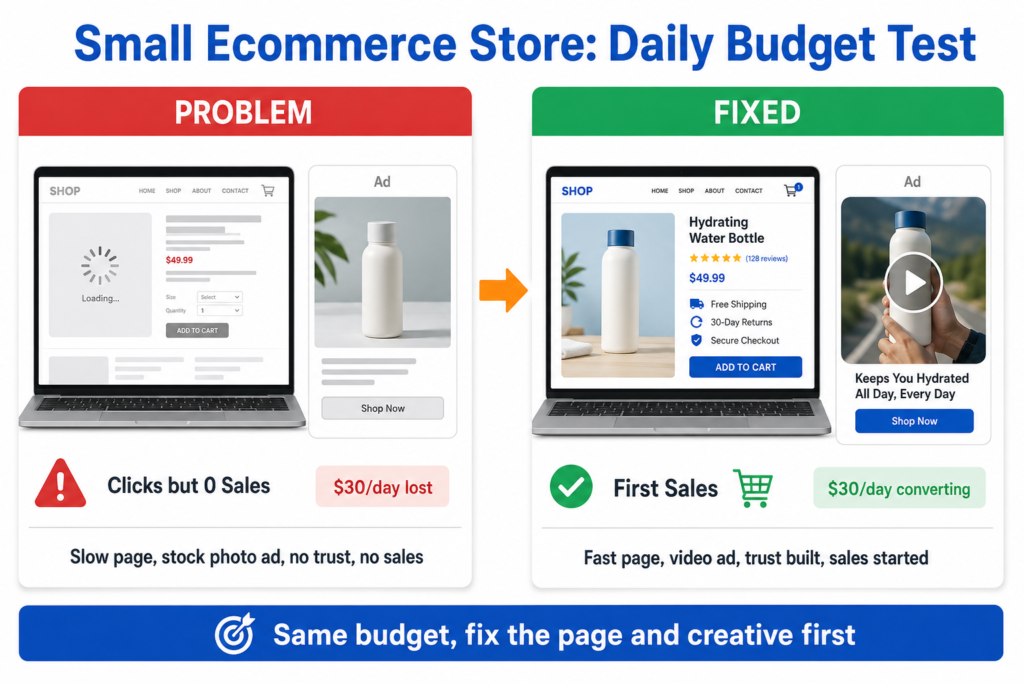
What the business wants: A small online store selling handmade skincare products wants to get its first online sales through Facebook ads.
What daily budget could make sense for testing: 25 to 35 dollars a day. The audience is national, the product needs discovery, and the system needs purchase or add to cart events to learn.
What result signals to watch: Cost per click, add to cart rate, cost per purchase, and return on ad spend. Also, watch the product page conversion rate, because if people click but do not buy, the issue is the page. Run those numbers weekly rather than daily, and calculate your return on ad spend across the whole test period so a single slow day does not push you into a premature decision.
What can go right: A strong product video showing the product in use, paired with a clean product page and a clear price, can attract clicks cheaply and drive first sales within the first two weeks.
What can go wrong: If the product page is slow, cluttered, or does not build trust (no reviews, no clear return policy, no visible shipping information), clicks will not convert. If the creative is a generic stock photo, engagement will be low, and cost per click will be high.
When to increase the budget: When the cost per purchase leaves a healthy margin, and the winning creative is clearly identified.
When to stop and fix the campaign: When clicks are coming, but no one is buying (fix the page), when cost per click is high (fix the creative), or when cost per purchase exceeds the margin (rethink the offer or audience).
Practical Checklist Before Setting a Daily Budget
Work through this before you commit your money.
You have a clear campaign goal (awareness, leads, sales, retargeting).
You have a clear offer a stranger would understand in seconds.
You have a defined audience, even if broad, and it is intentional.
You have at least one strong creative, ideally a short video or a clear product image.
Your landing page is live, relevant, and works well on mobile.
Your landing page loads fast on a phone.
Your pixel or tracking is set up and recording the right events.
Your conversion event is checked and firing correctly.
Your campaign structure is simple (one campaign, one or two ad sets, one or two ads).
Your daily budget matches the campaign goal (not too low for the objective you chose).
You have a plan for tracking lead or purchase quality, not just volume.
You are willing to give the test at least 7 to 14 days before judging.
Your ad does not contain false claims or misleading promises.
Frequently Asked Questions
Helpful Resources
About Meta Advantage Campaign Budget
Meta Business Help Center: Meta’s official guide to how daily and lifetime budgets work, including how the budget is distributed across ad sets. Essential reading before you set your first budget.
Meta Business Help Center explains how Meta’s auction determines which ads get shown and at what cost. Helps you understand why creative quality and relevance affect your spending.
Meta Business Help Center: Meta’s explanation of the learning phase, why it matters, and how budget affects it. Important for understanding why very small budgets can keep campaigns stuck in learning.
Meta: The main hub for all official Meta advertising guidance. The most reliable source for how Ads Manager works.
WordStream Facebook Ads Benchmarks
WordStream / LocaliQ is a widely cited benchmark report covering CPC, CPL, CTR, and CVR by industry for traffic and lead campaigns. The 2025 data (published late 2025) is the basis for many of the 2026 cost ranges referenced in this article.
Note: All benchmark numbers cited in this article are drawn from published 2026 reports by WordStream, Triple Whale, Databox, Stackmatix, and other analytics platforms. They are industry averages and general ranges, not guarantees. Your actual costs will vary based on your industry, audience, creative, offer, and timing.
Conclusion
There is no single perfect daily budget for Facebook ads in the USA. The right number depends on what you want to achieve, what your industry costs look like, and whether the rest of your setup is ready.
Start with a budget that matches your campaign goal and gives the system enough room to learn. For most small businesses, that means somewhere between 10 and 30 dollars a day for an initial test, and 20 to 50 dollars a day or more for serious lead generation or ecommerce. Keep the structure simple, give it time, and judge by real results rather than clicks.
Most importantly, fix your offer, your creative, and your landing page before you worry about increasing the budget. A well built campaign on a modest budget will usually outperform a sloppy campaign on a large one.