
Quick Answer
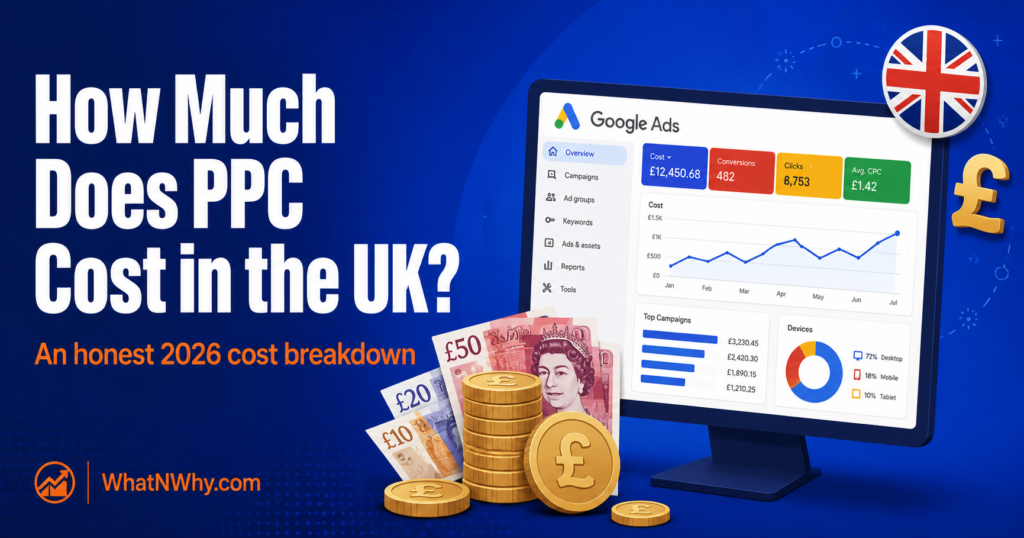
How much does it typically cost to run a PPC campaign in the UK? It depends heavily on your industry, location, and goals, so there is no single figure. As a general guide for 2026, many UK small businesses spend somewhere around £500 to £1,000 per month on ad spend to start, with cost per click for most sectors roughly in the £1.50 to £2.50 area, though it can be under £1 or well above £5 in competitive industries. If you hire help, management is a separate cost on top.
What are the main costs involved? Two big ones: the ad spend that goes to Google, and the management cost that goes to whoever runs the campaign. On top of those, there can be setup, conversion tracking, landing page, creative, and reporting costs.
How much should a small UK business budget first? Enough to gather meaningful data over a testing period, usually a few weeks at least. For many small businesses, that means an ad budget in the hundreds of pounds per month, set against a realistic cost per lead for their industry.
Is PPC expensive in the UK? It can be, especially in competitive sectors like legal and finance. But the better question is not whether clicks are cheap or expensive; it is whether the campaign produces customers at a cost your business can sustain.
How can a business avoid wasting PPC budget? Set up conversion tracking before you spend, send traffic to a strong landing page, target the right location and keywords, track phone calls, and judge results by real leads and sales rather than clicks.
Introduction
PPC pricing is frustratingly opaque. Ask what it costs, and most answers are either a vague “it depends” or a number pulled from thin air. The truth sits in between. Costs really do vary, but there are honest ranges and a clear way to think about them.
This guide gives you current UK figures for 2026, clearly marked as general guidance rather than guarantees, and a practical way to plan your budget. It is written for UK business owners in pounds sterling, with the local details that most guides skip, including VAT. No fake numbers, no promises of leads or profit, and no pressure to hire anyone. Just an honest picture of what PPC costs and how to spend it wisely.
A quick note on the figures here. PPC costs change with the market, your industry, and competition. Every range in this article is general guidance for 2026 and should be checked against current data for your specific situation before you commit to a budget.
How Much Does It Typically Cost to Run a PPC Campaign in the UK?
There is no single price, and anyone who gives you one without asking about your business is guessing. What you pay depends on your industry, your location, how competitive your keywords are, your campaign goal, and how well the campaign is set up.
That said, here is an honest general picture for 2026. Many UK small businesses begin with an ad budget somewhere around £500 to £1,000 per month, though plenty start lower or higher. The cost per click for most sectors sits roughly in the £1.50 to £2.50 area, but it can drop below £1 in low competition sectors and climb well past £5 in competitive ones. On top of ad spend, if you hire help, management is a separate cost.
Treat these as starting reference points, not promises. Your real costs depend on your specific situation, and they should be checked against current figures for your industry.
What Costs Are Included in a PPC Campaign?
People often think PPC cost means only the money that goes to Google. In reality, a campaign can involve several costs. Here is what they are, when they apply, why they matter, what moves them up or down, and how a beginner should think about each.
Ad spend. This is the money that goes to the ad platform, such as Google, each time someone clicks. It applies always, and it is usually the highest cost. It is higher in competitive industries and locations, and lower in less competitive ones. For a beginner, this is the core budget you control directly.
Management fee. This is what you pay a freelancer or agency to run the campaign. It applies only if you hire help. It matters because good management can improve results, and poor management can waste your ad spend. It is higher for larger budgets and more complex accounts. A beginner should see this as separate from ad spend, not part of it.
Setup fee. Some freelancers and agencies charge a one-off fee to build the campaign properly at the start. It applies mainly when you hire help. It matters because a good setup prevents expensive mistakes later. It is higher for complex accounts. Think of it as paying for solid foundations.
Tracking setup cost. This is the cost of installing and testing conversion tracking, often using GA4 and Google Tag Manager. It applies to almost every campaign that wants to measure results. It matters enormously because, without tracking, you cannot tell what is working. It can be low if you do it yourself, higher if you pay a specialist. A beginner should treat this as essential, not optional.
Landing page cost. This is the cost of building or improving the page your ads send people to. It applies when your current page is weak or missing. It matters because a poor page wastes every click. It is higher for custom builds. For a beginner, even small improvements to an existing page can help.
Creative cost. This is the cost of producing ad copy, images, or video. It applies more to display, social, and shopping campaigns than to simple search ads. It matters because weak creative reduces results. It is higher for video and design-heavy formats. A beginner running search ads may have very little creative cost.
Reporting cost. This is the cost of regular reporting and analysis, usually part of a management fee. It applies when you hire help or use paid reporting tools. It matters because reporting is how you make decisions. A beginner doing it alone can use the platform’s own free reports.
CRM or call tracking cost. This is the cost of tools that track leads through to sales, or that track which campaign generated each phone call. It applies when calls or lead quality matter, which is common for service businesses. It matters because it reveals the true value of your spend. A beginner with a phone-heavy business should budget for call tracking early.
PPC Ad Spend vs PPC Management Fees
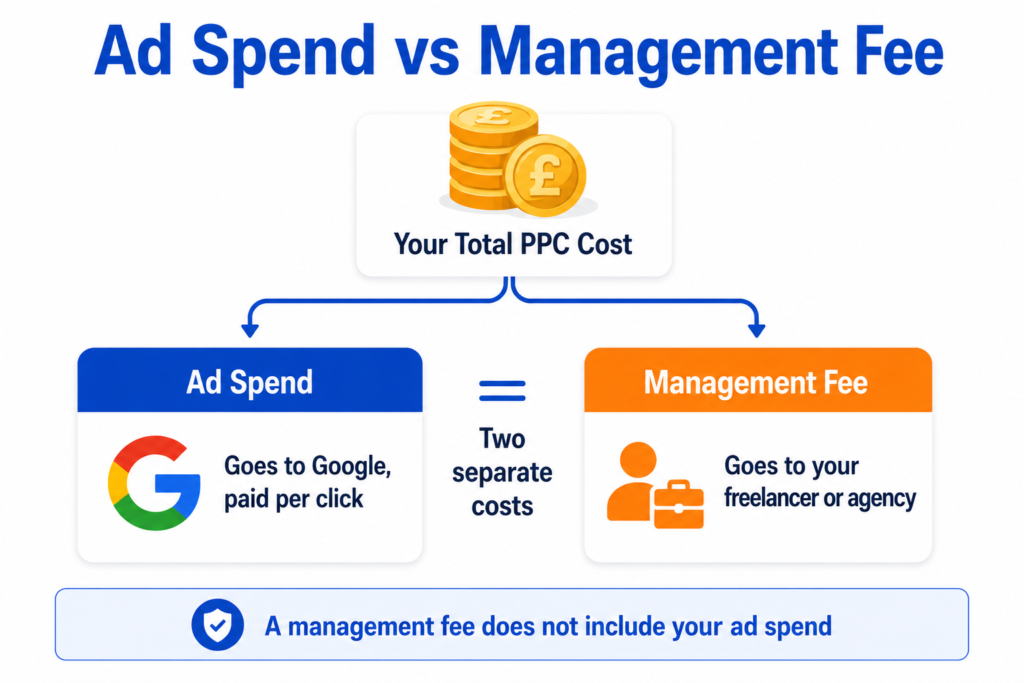
This is the single most important distinction to understand, because confusing the two leads to budgeting mistakes.
Ad spend is the money that goes to Google or another platform. The management fee is the money that goes to the person or agency running your campaigns. They are completely separate. If a freelancer quotes you £400 a month and your ad budget is £600 a month, your total monthly cost is £1,000, with £600 going to Google and £400 going to the freelancer.
A common beginner error is to assume a quoted management fee includes the ad spend. It usually does not. Always confirm what is included, and always budget for both. A marketing budget calculator makes this easier to plan, since it accounts for ad budget and management cost together rather than one at a time.
Typical PPC Cost Factors in the UK
Many things move your PPC cost up or down. Understanding them helps you see why two businesses can pay wildly different amounts.
Industry competition is the biggest factor. The more advertisers chasing the same customers, the higher the cost per click. Location matters too, with campaigns in major cities, especially London, generally costing more per click than the rest of the UK. Keyword intent affects cost, since high-intent buying keywords are more competitive than general research ones.
Campaign type changes the cost pattern, as search, shopping, Performance Max, display, remarketing, and social ads behave differently. Social platforms in particular follow a different cost logic, and how Meta Ads budgets work in practice is worth comparing if you are weighing both channels.
Audience size, ad quality, and landing page quality all play a role, because Google rewards relevant, high-quality ads and pages with better positions at lower cost. Your conversion rate matters, since a higher rate means more value from the same spend.
Tracking setup affects cost indirectly because poor tracking leads to poor decisions and wasted budget. Bidding strategy, seasonality, brand trust, and offer strength all influence results. And management experience matters, since a skilled hand can often get more from the same budget than an untrained one. None of these guarantees a particular cost, but together they explain the wide range.
If you want to understand how bidding works in practice, our guide on automating your PPC campaign bidding process explains when manual bidding makes sense and when automated strategies save money.
Google Ads Cost in the UK
Google Ads is the most common PPC platform for UK businesses, and it works as an auction. You do not simply pay your maximum bid. Google combines your bid with a quality measure to decide your position and the actual price, so a more relevant, higher-quality ad can rank well without the highest bid.
A specific UK point that many guides miss is VAT. Google adds 20 percent VAT to advertising costs for UK businesses. If you are VAT registered, you can usually reclaim it through your VAT return, but it still affects your cash flow. So a £1,000 ad budget means an invoice of around £1,200 including VAT. Always factor this in when planning.
Google Ads also charges in pounds for UK accounts by default. Make sure your billing currency is set to GBP so you are not exposed to currency conversion quirks.
PPC Cost Per Click in the UK
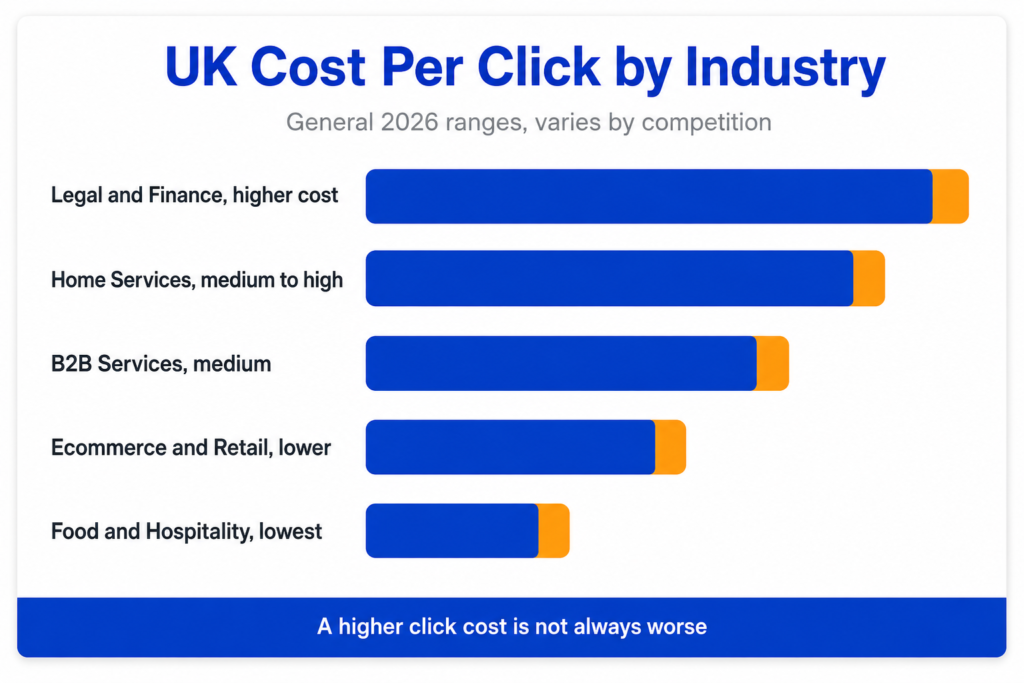
Cost per click, or CPC, is what you pay each time someone clicks your ad. It varies enormously by industry.
As a general guide for 2026, CPC for most UK small and medium businesses sits roughly in the £1.50 to £2.50 area. Competitive sectors like legal services and finance can run much higher, often several pounds and sometimes well above £5 per click, because a single client is worth a lot. Lower competition sectors like retail, food, and some ecommerce can sit under £1. These are general ranges that vary and should be checked against current data for your industry.
The important mindset shift is this. A low CPC is not automatically good, and a high CPC is not automatically bad. A £6 click that books a £3,000 job is excellent. A 50 pence click that never converts is expensive. CPC is only one piece of the cost picture. To check whether your clicks are actually profitable, run your numbers through our ROAS calculator and compare what you spend with what you earn back.
PPC Cost Per Lead in the UK
Cost per lead, or cost per acquisition, is usually a more useful number than CPC, because it tells you what you actually pay to get an enquiry or sale.
Cost per lead depends on your CPC and your conversion rate together. If clicks cost £2 and one in twenty visitors becomes a lead, your cost per lead is around £40. Improve the conversion rate to one in ten, and the cost per lead halves, without your CPC changing at all. This is why landing pages and offers matter so much.
You can run these numbers for your own business using our cost per lead calculator to see exactly what different CPC and conversion rate combinations produce.
There is no universal good cost per lead, because it depends on what a lead is worth to you. A lead worth £50 in profit and a lead worth £5,000 justify very different costs. Work out what a customer is worth to your business first, then judge your cost per lead against that.
PPC Cost for Small Businesses in the UK
For a small business, the honest message is that you do not need a huge budget to start, but you do need a realistic one. A budget too small to gather data will not give the campaign or you a fair chance to learn.
Many small UK businesses start with an ad budget in the hundreds of pounds per month, then adjust based on results. The right figure depends on your industry CPC and how many clicks you need to see meaningful data. In a high CPC sector, the same budget buys far fewer clicks, so you may need more to learn anything useful.
Do not judge a small budget campaign by clicks alone. Judge it by whether it produces enquiries or sales at a cost you can sustain. A small budget spent well on a focused campaign beats a slightly larger budget spread thinly across many.
PPC Cost for Local Service Businesses
Local service businesses, such as plumbers, electricians, and dental clinics, often have a particular cost pattern. Their keywords can be competitive, because a single job is valuable, but their targeting is narrow, since they only serve a local area.
For these businesses, phone calls are often the main conversion, so call tracking is an important cost to budget for. A local plumber, for example, might estimate the cost of a quote request by looking at the local CPC for their service and a realistic conversion rate, then comparing that cost per enquiry with the value of a typical job. A dental clinic might track both calls and online bookings to see the true cost per new patient.
The advantage for local businesses is focus. Tight location targeting keeps spending on the people who can actually become customers, which helps control costs.
PPC Cost for Ecommerce Stores
Ecommerce costs revolve around the value of a sale, not just the cost of a click. The key numbers are cost per purchase and return on ad spend, which compares revenue to ad cost.
Ecommerce CPCs are often lower than service sectors, but margins are usually tighter too, so the maths matters. A small ecommerce store should track purchases and their value accurately, then judge campaigns by whether the return on ad spend leaves a healthy margin after product and fulfilment costs. Shopping campaigns and Performance Max are common for ecommerce and behave differently from simple search ads, so expect a different cost pattern.
The honest point is that cheap clicks mean little if the products do not sell at a profitable return. Track value, not just visits.
PPC Cost for B2B Lead Generation
B2B lead generation often has higher costs per click and per lead, because the keywords are competitive and the audience is narrow. But a single B2B client can be worth a great deal, which can justify the higher cost.
The challenge in B2B is lead quality. A cheap form fill that never qualifies is worse than a more expensive one that becomes a client. A B2B service company should track demo requests and qualified leads separately, and judge cost against the value of a real client, not the volume of raw enquiries. This usually means connecting ad data to a CRM, even a simple one, to see which leads actually progress.
PPC Agency Pricing in the UK
Agencies typically charge a management fee on top of your ad spend. As a general guide for 2026, UK agency management fees often range from around £500 per month to several thousand, depending on your ad spend and the complexity of your account.
Agencies commonly price in one of a few ways: a percentage of your ad spend, often cited in the region of 10 to 20 percent, a flat monthly retainer, or a performance-based element. Sometimes there is a one-off setup fee too. None of these is automatically better. A percentage model scales with spend, while a flat retainer is more predictable.
Be cautious of any agency that guarantees specific results, since no one can honestly guarantee leads or sales from PPC. Judge an agency on its tracking setup, its reporting, its communication, and its honesty, not on promises.
Freelance PPC Pricing in the UK
Freelancers usually cost less than agencies and can be a good fit for smaller budgets. As a general guide for 2026, UK freelance PPC management often falls roughly in the £200 to £800 per month range, depending on the account size and the freelancer’s experience.
A good freelancer can offer focused attention and lower overheads than an agency. The trade-off is that you are relying on one person, so their skill, availability, and reliability matter. As with agencies, judge a freelancer on their tracking, reporting, and honesty, and be wary of guaranteed results.
Doing It Yourself vs Freelancer vs Agency
There is no single right answer here. It depends on your budget, your time, and your confidence. Here is an honest comparison.
| Factor | Do It Yourself | Freelancer | Agency |
| Cost | Only your ad spend and your time | Ad spend plus a moderate fee | Ad spend plus a higher fee |
| Control | Full control | Shared, usually responsive | Shared, more layers |
| Time required | High, you do everything | Low for you | Low for you |
| Skill needed | You must learn it | Provided by the freelancer | Provided by the team |
| Tracking setup quality | Depends on your skill | Usually good | Usually good to strong |
| Reporting | You build it | Provided | Provided, often detailed |
| Risk of mistakes | Higher while learning | Lower | Lower |
| Best fit | Very small budgets, willing to learn | Small to mid budgets wanting expertise affordably | Larger budgets or complex accounts |
The takeaway is to match the option to your situation. A confident beginner with a small budget and time can start alone. A business that wants expertise without a big overhead may prefer a freelancer. A larger or more complex operation may benefit from an agency.
How Much Should You Spend on PPC When Starting?
When starting, spend enough to gather meaningful data over a fair testing period, usually a few weeks at least. Too little, and neither you nor the platform can learn anything useful.
Work backwards from your industry. If clicks in your sector cost around £3 and you want enough clicks to see a pattern, you can estimate a sensible monthly testing budget. In a low CPC sector, the same budget buys more clicks, so you can learn for less.
Resist the urge to spread a small budget across many campaigns. Concentrate it on one focused campaign with clear targeting, so the spend and the data are not diluted. And treat the first period as a test, not a verdict. You are buying data and learning, not expecting a final result.
Working out the daily figure from a monthly testing target keeps the pacing steady, and a daily ad budget calculator does that conversion in one step.
How to Estimate a PPC Budget Before Launch
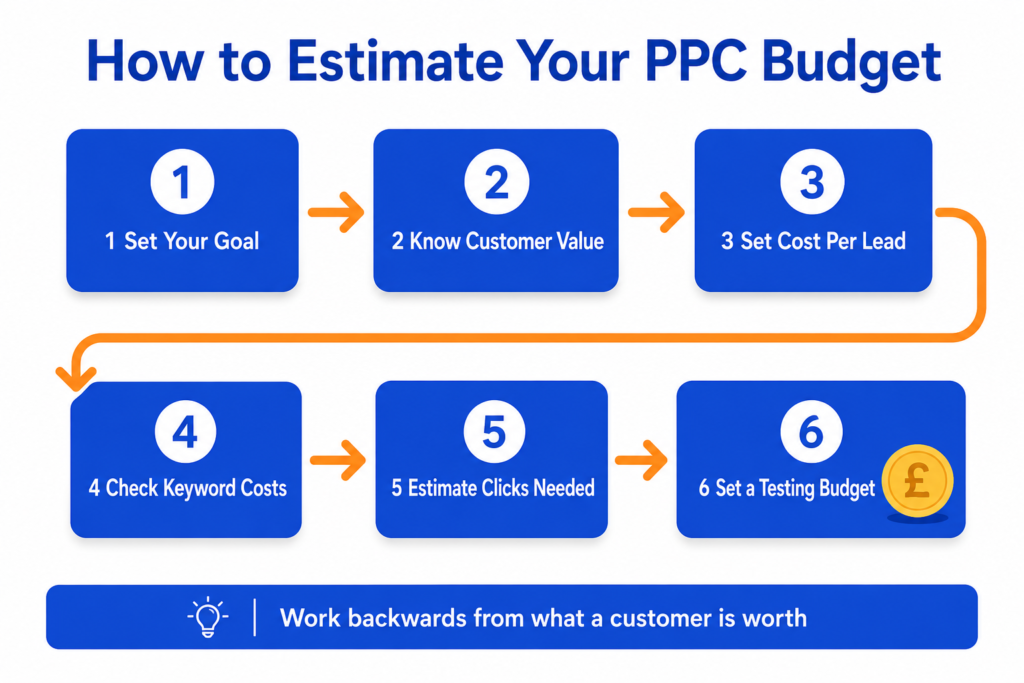
Here is a practical way to estimate a budget before you spend. This is a planning method, not a guarantee of results.
Step 1: Choose the campaign goal. Decide what you want, such as quote requests, calls, or sales.
Step 2: Estimate target customer value. Work out what a new customer is typically worth to you in profit. This anchors everything else.
Step 3: Estimate an acceptable cost per lead or sale. Based on that value, decide what you can afford to pay to acquire one and still profit.
Step 4: Check keyword cost data. Use the Google Ads Keyword Planner to see rough CPC estimates for your keywords in your area. Once you have those CPC estimates, plug them into our Google Ads cost calculator to see what a full campaign would cost across different budget levels.
Step 5: Estimate required clicks. Decide how many clicks you need to gather meaningful data, keeping in mind that not every click converts.
Step 6: Estimate your landing page conversion rate carefully. Be realistic and conservative. Overestimating here is a common and costly mistake.
Step 7: Decide on a testing budget. Combine your CPC estimate and required clicks into a monthly testing budget you are comfortable spending to learn. Rather than doing this by hand, a PPC budget calculator lets you test different CPC and click scenarios before committing any spend.
Step 8: Set conversion tracking before launch. Do not spend a penny until tracking is installed and tested, or you will not know what worked. If you are not sure where to start, our guide on PPC conversion tracking with analytics tools walks you through the full setup process step by step.
Step 9: Review lead or sale quality. Once data arrives, check whether the leads or sales are genuinely good, not just cheap.
Step 10: Decide whether to scale, pause, or fix. Based on real results, decide to grow what works, pause what does not, or fix the weak link, whether that is tracking, the page, or the targeting.
Why Some PPC Campaigns Become Expensive
Campaigns often become expensive not because PPC itself is dear, but because something is leaking budget.
Broad keywords without control can pull in irrelevant traffic that drains spend. A weak landing page wastes clicks that could have converted. Poor or missing conversion tracking hides what is working, so money keeps flowing to the wrong places. Counting low-quality leads as success teaches the campaign and the bidding system to find more of the same. Ignoring phone calls or mobile experience can mean paying for results you never see or losing visitors you paid for.
A common sign of this problem is when your Google Ads account shows active but no recent conversions, which usually points to a tracking gap rather than a campaign that genuinely produces nothing.
The pattern is consistent. Expensive campaigns usually have a fixable problem behind them. Find the leak before you blame the channel.
How Conversion Tracking Affects PPC Cost
Conversion tracking does not cost much to set up, but it has a huge effect on your true cost, because it reveals what your spend actually produces.
Without tracking, you see clicks and guesses. With it, you see which campaigns, keywords, and ads drive real enquiries and sales, so you can move budget toward what works. Poor tracking can hide the true cost of a campaign, making a wasteful one look acceptable or a good one look poor. It can also mislead automated bidding into chasing the wrong outcomes.
For the small cost of setting it up properly, tracking is one of the highest-value things you can do to control PPC cost. Always set it up and test it before you spend seriously.
How Landing Pages Affect PPC Cost
Your landing page has a direct effect on what PPC costs you, because it decides how many of your paid clicks turn into leads or sales.
A weak page makes PPC feel expensive, since you pay for clicks that bounce without converting. A clear, relevant, fast page with a strong offer turns more of those same clicks into customers, which lowers your effective cost per lead without changing your CPC at all. Google also considers landing page quality when setting your costs and positions, so a better page can help your ad performance too.
If your campaign brings clicks but few conversions, look hard at the page before spending more. Fixing the page is often cheaper and more effective than increasing the budget.
How to Avoid Wasting PPC Budget
These mistakes quietly drain the budget. Avoiding them protects your money.
• Starting without conversion tracking, so you cannot tell what works.
• Using broad keywords without control, which pulls in irrelevant clicks.
• Sending traffic to a weak landing page that wastes clicks.
• Tracking clicks instead of real actions like leads and sales.
• Ignoring phone calls when calls are a main way customers reach you.
• Ignoring lead quality and celebrating cheap leads that never convert.
• Using the wrong campaign objective for your goal.
• Trusting automation without good conversion data behind it.
• Changing campaigns too often, which prevents learning.
• Spreading a low budget across too many campaigns.
• Ignoring search terms and letting irrelevant queries through.
• Not checking the mobile experience, where many clicks happen.
• Not setting location targeting carefully, so you pay for the wrong areas.
• Not collecting sales feedback to confirm which leads became customers.
Two Practical Setup Scenarios
Scenario 1: Local service business in the UK
What the business wants: Quote requests and phone calls from people nearby who need their service.
What costs to expect: Ad spend based on a local service CPC, which can be moderate to high. Call tracking is an added cost. Possibly a freelancer fee if they do not run it themselves.
What should be tracked: Form submissions and phone calls, both tested. Without call tracking, a major source of leads is invisible.
What can go wrong: Broad keywords attract people outside the service area. Spam form fills are counted as leads. The budget is spread too thin across services.
What signals to watch: Cost per enquiry, the quality of those enquiries, and whether they turn into booked jobs.
When to increase budget: When qualified enquiries are coming in at a cost the business can sustain, and there is more demand to capture.
When to pause and fix: When enquiries are cheap but do not become jobs. Fix the targeting, the form, or what counts as a conversion before spending more.
Scenario 2: Ecommerce store in the UK
What the business wants: Profitable online sales.
What costs to expect: Ad spend based on a generally lower retail CPC, but against tighter margins. Possibly creative costs for shopping or Performance Max, and a management fee if outsourced.
What should be tracked: Purchases and their value, firing once per order, so return on ad spend can be measured accurately. The minimum return your store needs before ad costs eat into profit is worth knowing first, and a break even ROAS calculator gives you that number.
What can go wrong: Counting the same purchase twice. Ignoring product margin and chasing revenue that does not profit. Thin tracking that hides the true return.
What signals to watch: Cost per purchase, return on ad spend, and whether returns or refunds are eating into profit.
When to increase budget: When sales come in at a rate that leaves a healthy margin after all costs.
When to pause and fix: When clicks come, but sales do not, which usually points to the product page or offer rather than the ad.
Practical UK PPC Budget Checklist
Work through this before and after you launch.
Clear campaign goal defined.
A realistic starting budget for your industry and goal.
Target location defined precisely.
Keyword intent reviewed, focusing on buying intent.
Your landing page checked on desktop and mobile.
Offer clear and compelling.
Conversion tracking installed and tested.
Phone call tracking considered if calls matter.
Lead or sale quality reviewed, not just volume.
Management cost understood and separated from ad spend.
Any setup cost understood up front.
VAT factored into your budget.
Search terms reviewed, with negatives added.
Budget pacing monitored so spend is steady.
Reports checked at least weekly.
Sales feedback collected to confirm which leads converted.
A clear plan to pause, fix, or scale based on results.
Frequently Asked Questions
Helpful Resources
Google Ads Help
Source: Google. official help centre for Google Ads, covering how costs, bidding, and billing work. The most reliable place to confirm how the platform charges.
About Billing and Budgets
Source: Google Ads Help. Google’s official guidance on budgets, billing, and how charges work, useful for understanding spend limits and VAT handling.
Google Ads Keyword Planner
Source: Google Ads Help. Google’s tool for researching keywords and seeing estimated cost ranges. Useful for building a realistic budget before launch.
Google Analytics Help
Source: Google. Official help for GA4, useful for setting up the conversion measurement that reveals your true cost per result.
Google Tag Manager Help
Source: Google Official help for GTM. useful for deploying and testing the conversion tracking that your budget decisions depend on.
Microsoft Advertising Help
Source: Microsoft. Official help for Microsoft Advertising, useful if you also consider Bing Ads, which can sometimes offer lower costs.
Conclusion
So, how much does a PPC campaign cost in the UK? Honestly, it depends, but now you have the ranges and the reasoning to plan properly. For 2026, many small businesses start with ad spend in the hundreds to around a thousand pounds per month, with clicks in most sectors roughly in the £1.50 to £2.50 area, plus management if they hire help, and VAT on top. Competitive sectors cost more, and every figure varies by your specific situation.
The most important shift is to stop judging PPC by the price of a click. What matters is the cost of acquiring a customer and whether that cost leaves you a profit. A campaign with higher clicks but strong tracking, a good page, and quality leads can be a far better investment than a cheap one that produces nothing.
Set a realistic budget, install tracking before you spend, send traffic to a strong page, and judge results by real leads and sales over a fair testing period. Do that, and you will spend your PPC budget with your eyes open rather than closed. Check current figures for your industry before you commit, since costs change, and start small enough to learn before you scale.