


Quick Answer
What are effective strategies for finding new content marketing topics? The most effective strategies start with real sources, not guesswork. These include your customers’ questions, search intent research, Google autocomplete and related searches, People Also Ask, question research tools, keyword tools, competitor content gaps, sales and support conversations, forums and communities, social media comments, your old content data, Google Search Console, and AI tools used with human review. The strongest ideas show up in more than one of these.
Where should beginners start? Start with the questions your customers actually ask. They are the easiest source, they are always relevant, and they almost never run dry.
How do you know if a topic is worth writing about? Check that it matches a real search intent, connects to your business, solves an audience problem, and has steady interest. A topic that passes those checks is worth your time.
How do you avoid choosing random topics? Run every idea through a quick validation before you write. If it does not connect to your audience and your business, skip it.
Why should topic ideas match search intent and business goals? Because a topic that does not match what people want will not satisfy readers, and a topic that does not connect to your business attracts the wrong audience. The best topics do both.
Introduction
Running out of content ideas is common, but the real problem is usually not a shortage of ideas. It is the absence of a process. People sit down to brainstorm, force out a few random topics, and wonder why the content goes nowhere.
Good topics are not invented from thin air. They are found in the questions people already ask, and the gaps competitors leave behind. This guide gives you a repeatable set of strategies to find those topics, a way to validate them before you write, and a simple method to turn them into a plan. No random lists, no hype, and no fake numbers.
What Are Content Marketing Topics?
Content marketing topics are the subjects you create content about to help your audience and support your business. A topic is the idea behind a blog post, a video, an email, a guide, or a social post.
It helps to separate a topic from a title. The topic is the subject, such as how to choose a service provider. The title is how you frame it, such as “How to Choose a Service Provider You Can Trust”. Topic research is about finding the right subjects first. The titles come later. When you do get to the titles, our meta title and description preview tool shows how each one will actually look in search results.
Good topics are not random. They sit at the meeting point of three things: what your audience wants to know, what your business does, and what you can genuinely help with. Topic research is simply the work of finding those overlaps on purpose.
Why Topic Research Matters in Content Marketing
Topic research matters because it decides whether your content has a chance before you write a single word. A brilliant article on the wrong topic still fails.
Research is not just brainstorming random blog ideas. It is the difference between guessing and knowing. When you base topics on real questions and real demand, you create content that people are actually looking for, which gives it a reason to exist and a chance to be found.
It also saves you from wasted effort. Writing takes time. Researching the topic first means you spend that time on subjects that can pay off, rather than on posts nobody searches for. The honest version is that no method guarantees results, and not every researched topic will succeed. But research stacks the odds in your favour.
What Makes a Good Content Marketing Topic?
A good content marketing topic does four things at once. It solves a problem or answers a question, it supports a business goal, it fits your audience, and you can cover it genuinely well.
Miss any of these and the topic weakens. A topic that gets searches but does not connect to your business brings the wrong visitors. A topic tied to your business that nobody searches for gets no traffic. A topic you cannot cover well will not satisfy anyone. The sweet spot is where all four line up.
Keyword volume is part of the picture, but it is not the whole picture. A high-volume topic with the wrong intent or no link to your business is often a worse choice than a lower-volume topic that fits perfectly and reaches people close to a decision. Intent and relevance matter more than raw numbers.
Effective Strategies for Finding New Content Marketing Topics
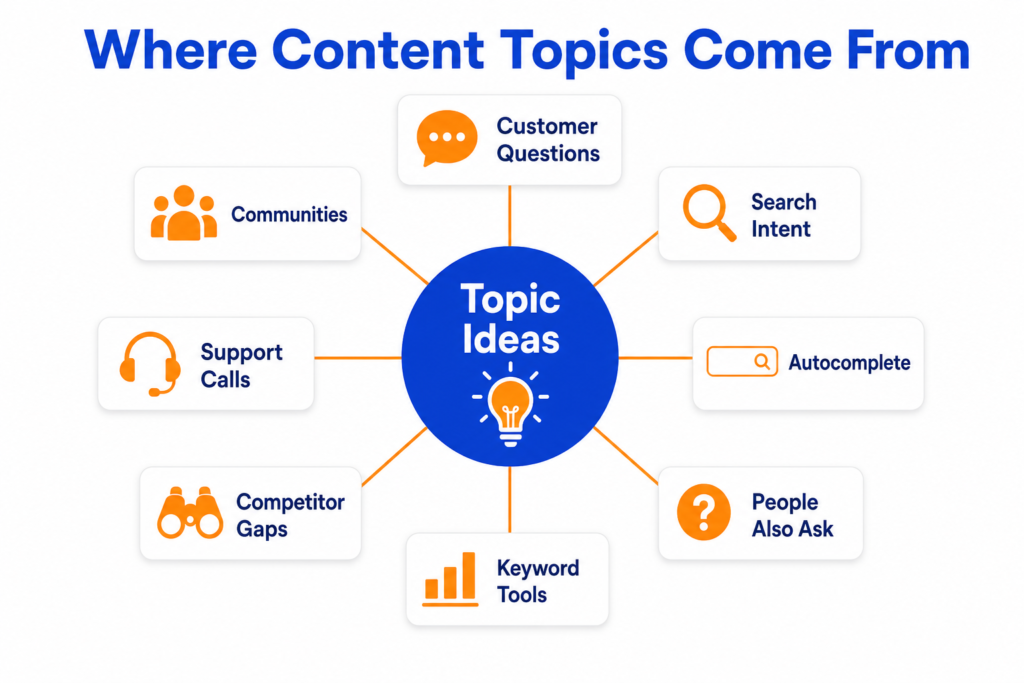
Here are the strategies that reliably surface good topics. For each one, you get what it means, why it works, how to apply it, an example, and a mistake to avoid. Use several together, because the strongest ideas appear in more than one.
Start With Customer Questions
What it means: Use the questions your customers ask you directly as topic ideas.
Why it works: These questions are real, relevant, and repetitive. If one customer asks, others are searching for the same thing.
How to apply it: Keep a running list of every question customers ask, in person, by email, and on calls. Each one is a potential topic.
Example: A local service business notices customers keep asking how to prepare before a visit, so it writes a clear guide answering exactly that.
Mistake to avoid: Forgetting to write the questions down, then struggling to remember them later.
Use Search Intent Research
What it means: Look at what people actually want when they search a term, not just the words they type.
Why it works: Matching intent is what makes content useful and findable. The same phrase can hide very different needs.
How to apply it: Search for your candidate topic and study the results. Do people want a how-to, a comparison, a definition, or a product? Build the topic around that.
Example: A marketer searching for a product term sees that the top results are buying guides, so they plan a guide rather than a sales page.
Mistake to avoid: Assuming you know the intent without checking what already ranks.
Check Google Autocomplete and Related Searches
What it means: Use Google’s own suggestions to find what people search for around a topic.
Why it works: Autocomplete and related searches reflect real, repeated queries, straight from the source.
How to apply it: Start typing a topic into Google and note the suggestions. Scroll to the related searches at the bottom of the results for more.
Example: A consultant types a core topic and finds several specific follow-up phrases people search for, each a possible post.
Mistake to avoid: Ignoring these free signals and relying only on your own ideas.
Use People Also Ask Style Questions
What it means: Use the question boxes in Google results to find the questions people ask around a topic.
Why it works: They show a map of related questions, often phrased exactly as people search them.
How to apply it: Search your topic, open the People Also Ask questions, and collect the ones relevant to your business.
Example: An ecommerce store finds several common questions about caring for a product and turns them into a care guide and an FAQ.
Mistake to avoid: Copying the questions without actually answering them well in your content. Those same question formats now feed AI answers too, and optimising your posts for AI Overviews covers how those sources get picked.
Use AnswerThePublic Style Question Research
What it means: Use a question research tool that gathers the questions people ask around a keyword.
Why it works: It surfaces a wide range of real questions quickly, including ones you would not think of.
How to apply it: Enter a core topic into a tool like AnswerThePublic and review the questions it returns, keeping the ones that fit.
Example: A SaaS company enters a workflow term and finds dozens of how-to and what-is questions to build product education content around.
Mistake to avoid: Treating every result as worth writing. Many will not fit your business, so filter.
Use Semrush or Keyword Research Tools
What it means: Use keyword tools to see search demand and related terms for your topics.
Why it works: They confirm whether real interest exists and reveal related topics you may have missed.
How to apply it: Enter your topic into a tool like Semrush or a similar keyword tool, review demand and related keywords, and note strong candidates.
Example: A marketing blog checks demand for a topic, then discovers several related long tail topics worth covering too.
Mistake to avoid: Chasing volume alone while ignoring intent and business fit.
Review Competitor Content Gaps
What it means: Look at what competitors cover, and find the topics they handle poorly or miss entirely.
Why it works: A gap is an opening. If an important topic is covered weakly, you can do it better.
How to apply it: Study a few competitors’ content. Note topics they cover well, topics they cover badly, and topics they skip. The weak and missing ones are opportunities.
Example: A B2B company sees competitors explain a process but never compare the common approaches, so it writes the comparison that they are all missing.
Mistake to avoid: Copying competitor topics without adding anything more useful.
Use Sales Calls and Support Conversations
What it means: Mine the conversations your sales and support teams have for recurring questions and objections.
Why it works: These reveal the real concerns that drive or block a decision, which are powerful topics.
How to apply it: Ask your sales and support people what questions and objections come up most, and turn each into a topic.
Example: A B2B service company hears the same objection in sales calls and writes an article that answers it honestly, so prospects arrive already reassured.
Mistake to avoid: Treating sales and support as separate from content, and missing this goldmine.
Check Forums and Communities
What it means: Look at the questions people ask each other in online communities and forums in your field.
Why it works: These are honest, unfiltered questions, often evergreen, that show what people really struggle with.
How to apply it: Find the communities your audience uses and note the questions that come up often.
Example: A consultant spots a recurring beginner question in a community and writes the clear guide nobody there has linked to.
Mistake to avoid: Promoting yourself in those communities instead of quietly learning from them.
Study Social Media Comments
What it means: Read the comments on your posts and on others’ posts in your field for questions and reactions.
Why it works: Comments show what people are curious about, confused by, or care about right now.
How to apply it: Scan comments on relevant social posts and note recurring questions or strong reactions as topic ideas.
Example: A small business sees the same question under several of its posts and turns it into a full article.
Mistake to avoid: Reading comments for praise only and ignoring the questions hidden in them.
Review Old Content Performance
What it means: Look at which of your existing pieces keep performing, and use them to find new topics.
Why it works: Your own data shows what your audience responds to, which points to related topics worth covering.
How to apply it: Review which posts get steady visits or engagement over time, then plan related and deeper topics around them.
Example: A blog notices that one guide keeps drawing visitors and creates a small cluster of related posts around the same subject.
Mistake to avoid: Ignoring your own data and starting from scratch every time.
Use Google Search Console Data
What it means: Use Search Console to see the real searches that already bring people to your site.
Why it works: It shows queries you are appearing for, including ones you never targeted, which are ready-made topic ideas.
How to apply it: Look at the queries in Search Console, especially ones where you appear but rank low, and create or improve content for the promising ones. Appearing without ranking is its own problem, and why a page can be indexed but never rank covers what usually causes it.
Example: A site finds it appears for a question it never wrote about directly, so it creates a focused post to answer it properly.
Mistake to avoid: Never opening Search Console and missing the clearest signal you have.
Use AI Tools for Brainstorming With Human Review
What it means: Use AI tools to brainstorm angles and questions quickly, then review everything with human judgement.
Why it works: AI can expand a seed idea into many angles fast, which is useful for getting unstuck.
How to apply it: Ask an AI tool to suggest topic angles or questions around a subject, then check each one for accuracy, relevance, and usefulness before you keep it.
Example: A marketer uses AI to generate twenty angles on a topic, then keeps the few that genuinely fit the business and the audience.
Mistake to avoid: Publishing AI ideas without checking them. AI can suggest topics that are off, generic, or simply wrong, so the human review is what keeps quality up.
How to Validate a Content Topic Before Writing
Finding ideas is only half the job. Before you write, run each candidate through these checks. This is the step that separates a real process from random publishing.
Search intent. Do you understand what people want from this topic, and can you deliver it?
Business relevance. Does the topic connect to your services, products, or audience?
Audience pain point. Does it solve a real problem your audience has?
Search demand. Is there steady interest, rather than a one-time blip?
Keyword difficulty. How hard is it to compete? A newer site often does better starting with less crowded topics.
Trend stability. Is interest steady over time, or fading? A tool like Google Trends can show this.
Competition quality. Look at what ranks. If it is weak, you have an opening. If it is excellent, you need a strong angle.
Content depth needed. How thoroughly must you cover this to be useful, and can you do it justice?
Internal linking opportunity. Does the topic connect to your other pages and services?
Conversion relevance. Does it attract people who could become customers, or only casual readers?
Freshness need. Will this need frequent updates, or will it stay relevant with little maintenance?
Original value. Can you add something beyond what already exists, such as real experience or a clearer explanation?
A topic that passes most of these is worth writing. One that fails several is usually not, no matter how appealing it looks at first.
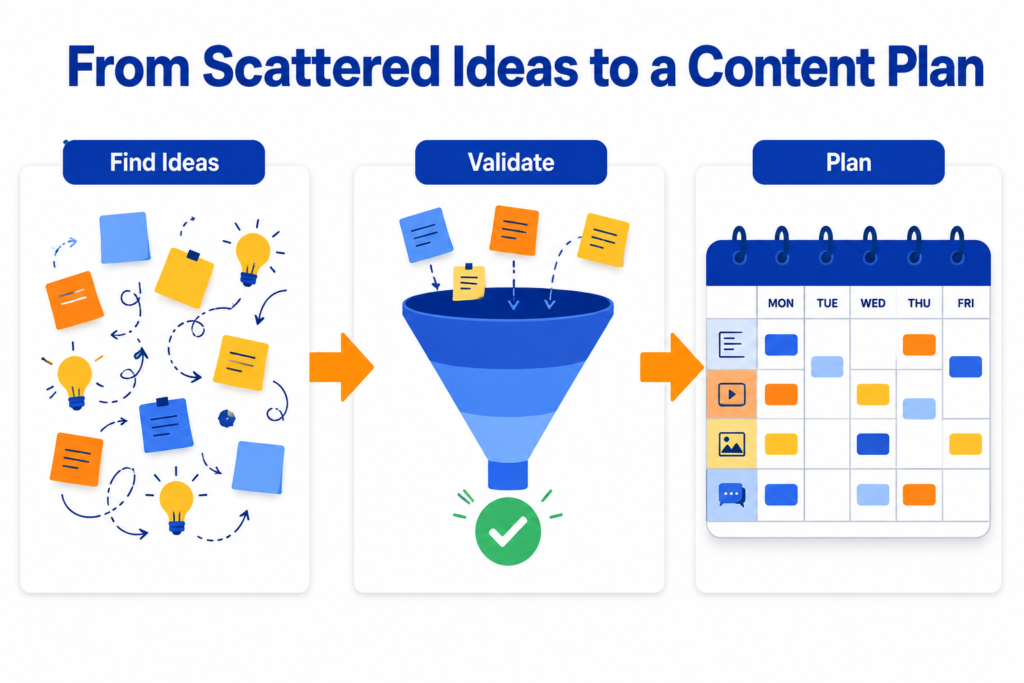
How to Turn Topic Ideas Into a Content Plan
A list of validated topics is not a plan yet. Here is how to turn ideas into a system you can actually execute. Topics are one part of a bigger picture, and the key elements of a content marketing strategy covers everything that surrounds them.
Group topics by audience problem. Sort your topics under the main problems your audience has, so you can see where you have depth and where you have gaps.
Separate evergreen topics from timely topics. Mark which topics stay useful for years and which are tied to a moment. This helps you balance your calendar. Knowing which of your topics are genuinely evergreen is worth doing properly, since it changes how much maintenance each piece will need.
Create topic clusters. Group closely related topics around a main subject so they support each other.
Choose one pillar article. For each cluster, pick the main, thorough article that covers the subject broadly.
Create supporting articles. Plan focused pieces that each answer a related question and point back to the pillar.
Map topics to buyer journey stages. Match topics to where people are, from just discovering a problem to comparing options to being ready to buy.
Assign content formats. Decide whether each topic works best as a blog post, an FAQ, a video, an email, a guide, or a social post. A strong topic can often become several of these.
Build a simple content calendar. Schedule what you will publish and when, at a pace you can sustain. Our content calendar generator turns your topic list and posting frequency into a schedule.
Plan internal links. Decide how each new piece will link to related pages and to your services.
Plan updates for important articles. Mark which pieces you will review and refresh over time, so your best content stays current.
Content Marketing Topic Examples by Business Type
Here are practical topic examples for different businesses. These are example angles to spark ideas, not guaranteed winners, and they contain no performance claims.
Small business: “How to choose a [service] provider”, a cost guide for your service, common mistakes people make, and a beginner’s guide to your main offering.
Local service business: “How to prepare for a [service] visit”, “signs you need [service]”, a seasonal maintenance checklist, and “what to ask before hiring a [trade]”.
Ecommerce brand: Buying guides, such as “how to choose the right [product]”, product care guides, comparisons such as “[option A] vs [option B]”, and “how to use [product]” guides.
B2B service company: “What is [process] and why it matters”, answers to common sales objections, “how to evaluate a [service] partner”, and comparisons of common approaches.
SaaS company: “How to [achieve the outcome the product helps with]”, step-by-step task guides, clear definitions, and common mistakes in the workflow your product supports.
Personal brand or consultant: Answers to the questions clients ask most, “how to get started with [topic]”, beginner mistakes in your field, and frameworks you use in your work.
Digital marketing blog: Guides on strategy, SEO basics, content planning, keyword research, and paid ads fundamentals, plus “how to measure [metric]” explainers.
The pattern is the same across all of them. The topics come from real questions tied to the business, which is exactly what makes them worth writing.
Common Mistakes When Choosing Content Topics
These mistakes waste effort and lead to content that goes nowhere. Avoid them.
- Choosing topics only because they have high search volume, while ignoring relevance and intent
- Ignoring search intent and writing something that does not match what people want
- Copying competitors without adding anything more useful
- Writing for keywords instead of for readers
- Choosing topics unrelated to your business, which attract the wrong audience
- Publishing random topics with no content plan behind them
- Ignoring customer questions, the richest source you have
- Ignoring data from your old content, which already shows what works
- Using AI ideas without human review, so off or generic topics slip through
- Not checking competition quality before committing to a topic
- Not planning internal links, leaving new articles stranded
- Not updating useful content later, so your best pieces go stale
Practical Content Topic Research Checklist
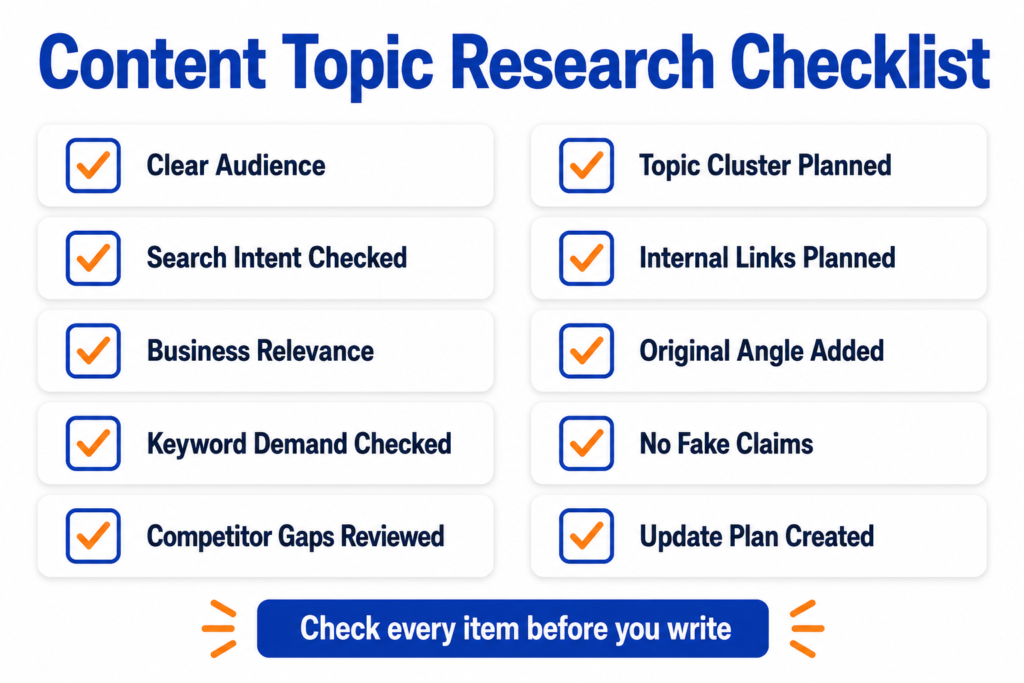
Run each topic through this before you commit to writing.
- A clear audience in mind
- A clear business goal for the content
- Customer questions collected and reviewed
- Search intent checked against real results
- Keyword demand checked
- Keyword difficulty reviewed
- Competitor gaps reviewed
- A topic cluster planned around the subject
- Internal links planned to related pages and services
- A content format chosen
- Business relevance confirmed
- An original angle added
- Helpful examples planned
- No copied content
- No fake claims or invented numbers
- An update plan for important pieces
- A short FAQ section where useful
Frequently Asked Questions
Helpful Resources
Source: Google Search Central. Google’s core guidance on building content that can appear in Search, useful for understanding what makes a topic worth covering for SEO.
Source: Google. The help centre for Google Search Console, where you can find the real searches bringing people to your site, which are ready-made topic ideas.
Source: Google. Help for Google Trends, the tool that shows whether interest in a topic is steady or fading, useful for checking a topic’s stability.
Source: Google. Official help for Google Analytics, so you can see which existing content performs and use it to find related topics.
Source: Semrush. Documentation for Semrush’s keyword and content tools, useful when researching demand and related terms for potential topics.
Source: AnswerThePublic. A question research tool that gathers the questions people ask around a keyword, helpful for surfacing question-based topics quickly.
Conclusion
Finding new content marketing topics is not about waiting for inspiration. It is a repeatable process built on real sources, your customers’ questions, search data, competitor gaps, and your own performance data. The ideas are already out there. Your job is to gather them on purpose.
Use several of the strategies in this guide together, since the strongest topics show up in more than one source. Validate each idea before you write, so you spend your time on subjects that can actually pay off. Then turn your validated topics into a plan with clusters, formats, and internal links.
No method guarantees results, and not every topic will succeed. But with a real process behind your topic choices, far more of your content will have a reason to exist and a chance to be found. Start with your customers’ questions, validate as you go, and build from there.